
Cavs: the Duels
2012-12-02Over the course of the season, Cavs:the Blog writers will square off in a series of head-to-head debates over a variety of topics. At the conclusion of each; you select a winner.
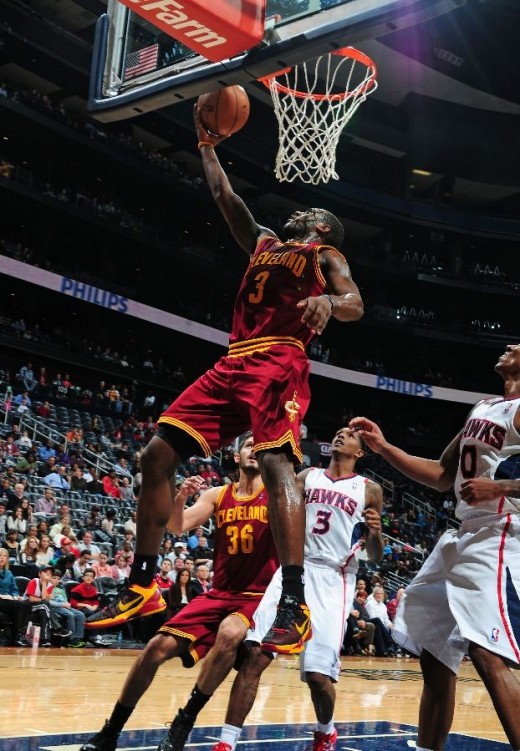
Did you see that pass that Dion threw to Alonzo Gee off the rim at the end of the Atlanta game for the winner? Who knew Dion had such a firm understanding of trajectories and physics!!
The first topic today pits Kevin against Tom, in a battle of “Dion Waiters is unquestionably one of the NBA’s five most impressive rookies” versus “I’ll question that”.
Kevin (sent prior to Friday night’s games): I’ll start this off with lists of rankings for Dion compared to his rookie competition, broken into four categories. The rankings include the 25 rookies who played 150 minutes prior to November 30th.
Strength of Schedule
- 1st – Ratio of away games to home games. Cleveland has been on the road a lot.
- 8th – Highest opponent win percentage
Team Burden
- 1st (tie) – Ratio of games started
- 2nd – percentage of team minutes played
- 4th – usage
Production
- 1st – ratio of steals to fouls
- 5th – points per 40 minutes, pace adjusted
- 6th – Three-point percentage (15 players with over five attempts)
- 6th – assists per 40 minutes, pace adjusted
- 7th – Pure Point Rating (PPR, a variation on assist-to-turnover ratio)
Age
Of everyone ranked higher, the entire list within sixteen months of Waiters includes:
- Anthony Davis for usage rate, points, and opponent win percentage (only six games played)
- Austin Rivers for assists and PPR
- Moe Harkless for opponent win percentage
That’s it. Basically, against a cumbersome schedule, facing-off against the opponent’s starters, and playing crunch-time, Cleveland requires Dion to handle a heavy-load, all at a precariously young age. And he’s helping, spreading the floor and moving the ball; two areas where Cleveland struggles otherwise.
Today, I list only Damian Lillard, Michael Kidd-Gilchrist and Anthony Davis above him for “most impressive rookie”.
Tom (sent prior to Friday’s game): How does it feel to be hanging from a mile-high cliff using silly string? It looks like it might hold, so long as no one exposes the word “impressive”. Impressive is a relative term, it is based on expectations. In that sense, when Lance Allred made history in 2008, we could have declared him the most impressive NBA rookie ever. But should we? This is like the MVP debate, it’s about semantics, and there is no clear winner so long as there is no agreed upon metrics. It’s one thing to say “not every rookie has had to battle LeBron James and Tony Allen in their first month”, it’s another to say “at a precariously young age”. What stops us from saying “while battling a hard-nosed coach that randomly benches him unfairly” or “and he did this while playing his overweight butt into game shape!” Anything can be impressive if you frame it right.
Using the 1st bullet, the road/home ratio, the implication is that those games were more challenging, and thus, there will be an across the board drop in performance among all Cavs players that Waiters can’t overcome. Too simplistic. Do you expect Anderson Varejao’s PER to be 30 when the Cavs start playing some cupcake teams at home? Once the usage burden eases and the SOS evens out will Andy be in the MVP discussion? I doubt it. Make no mistake, Waiters is going through the gauntlet right now. I’ll be “impressed” if he emerges and raises his game to a higher level. Not until then.
Team burden? Minutes played? Jeremy Pargo’s minutes tripled from last season. So did his PER. Maybe the next argument can be “if only Dion Waiters got more deserved minutes, his value would increase.” I’ve shown in my Don’t. Trade. Varejao. post that in his career arc, more usage has meant better things. More production, more efficiency, more notoriety, and more value – the things that truly impress. Yes, it lends that with less people treating Waiters as the head of the snake, and with a less grueling schedule, he will be in an environment more conducive to success. I get that. Let’s be impressed by what people do, not what they’re going to do. I’m going to ignore SOS and team burden. How many people were upset when the Cavs barely beat that D-league of a Wizards team on opening night? No one. This glass-half-full-all-the-time-thing doesn’t hold up to scrutiny. Actually among a few of the more “distinguished” people here, it’s more like “the glass might be empty, but we’re DEAD SURE that someone is going to be filling it with Cognac shortly, so please shut up.”
Kevin (sent prior to Saturday’s game): OK, with you throwing down the ‘semantics’ hammer, I up the ante: Dion Waiters ranks top-five for ‘best’ rookie of this young season.
Carrying on; from 1997 through 2008, NBA home teams won 61% of games and home court carries value of 3 to 3.5 points. I won’t argue a dramatic impact, but teams, and by extension, players, are better at home. Over small samples, some credit needs given for facing road-heavy schedules.
Varejao is an outlier in many ways. In Basketball on Paper, Dean Oliver developed Skill Curves (definition is here), where he tracked individual offensive rating as a function of a player’s usage over many games. The general rule, as makes sense, is that the less required of a player, the more efficient he performs. This article provides quantitative averages of how usage impacts offensive rating. Using those numbers, if Waiters usage decreased from 25 to 15, his offensive rating calculates at 119…identical to 24-year-old Kyle Singler; which brings me back to age. If you bought Basketball Prospectus this season, they included an article utilizing data since 1978, fitting a regression model to assess year-to-year performance improvements as players age. Generally, players improve rapidly from 18 to 22, and continue at a slower rate through age 26. At 20, Dion still treads through early stages of development.
You are critical of outright expecting improvement, as if a given, but how can you view 30+ years of NBA trends, and say, “I don’t see it happening here”? Are you one of those people that hate science?
Tom (sent prior to Saturday’s game): You want me to drop some ‘science’ on your ass? I keep PER out of this debate as I think your “it’s been a burden” narrative parry’s that, and it doesn’t account for sample size which can widely vary between players at this juncture. But I like dropping stats too. Among rookies, Dion Waiters ranks:
Tied 19th in Win Shares (source: bball-ref)
Tied 9th in Estimated Wins Added (EWA, source: hollinger)
No other information is going to make my case so succinctly. Waiters would unfairly struggle in these stats if he was missing games or playing time – but it’s been the opposite. He’s getting opportunities to create positive value. Honestly I could have just made that my entire post. That alone allows one to question whether Dion Waiters belongs on the top-5 most impressive rookies list. But low hanging fruit is boring and I like killing ants with ICBMs so…
33rd in Offensive Rating (18th if filtering by >= 150 minutes played)
48th in Defensive Rating (19th see above)
Dion is relatively far from being ‘among the five best rookies’; a lot of your trends need to align perfectly for that to happen. While they may, you are too optimistic to ‘unquestionably’ decree it.
Kevin (sent prior to Saturday’s game): Do I need to teach “Advanced Stats 101”? As a direct derivation of PER; using EWA, while claiming to ‘keep PER out of the debate’ is contradictory. I like PER, but it lacks accounting for quality of opposition; how many rookies are playing against back-ups and in garbage time? That has to be accounted for. By Hollinger’s own admission, PER is also a poor defensive quantifier.
Defensive rating is useless, and by extension, so are Defensive Win Shares built from it. Individual Defensive Rating almost entirely credits the strength of the team, not the player; unless you want to argue that Louis Williams is performing 3 points per 100 possessions better than Anderson Varejao this season. I’ll assume not, so let’s move on.
Offensive Rating is awesome (see earlier deference to Dean Oliver), but should never receive mention without the accompanying usage; provided you do not believe Steve Kerr ranks as a better offensive player than Michael Jordan.
David Stern should sanction you for gross negligence in the use of advanced stats.
Moving on, there are two ‘genres’ of advanced stats: box score generated and scoreboard generated. Each of your stats are box-score derived, the other set relies on plus /minus.
My very simplified understanding (Here’s something more complex) of Adjusted Plus / Minus (APM) is that the following equation represents every line-up matchup over the course of an NBA season.
MARGIN = Home Court + X1 + X2 + X3 + X4 + X5 – Y1 – Y2 – Y3 – Y4 – Y5
MARGIN is the differential outcome of the matchup, prorated to 100 possessions. Home Court is the league-wide average advantage per 100 possessions. Each variable is an NBA player; the X guys are home, and the Y guys away. Over a season, up to 60000 of these equations run through a regression model. Every variable ends up a number, which indicates how many additional points are added to a team’s scoring margin by a given player, compared to league average.
Regularization is a statistical technique that improves the accuracy of APM, and provides improvement in the prediction of future game outcomes. The 2012 – 2013 Basketball Prospectus discusses a projection contest during the 2011 – 2012 season. Six stats systems competed, and of the thirty NBA teams, the model based on RAPM closest predicted the win totals of seven squads, leading all systems.
Everyone knows that many actions occur that are not capably captured in the box score. RAPM offers a means to answer the question, “Who does the most things to help their team win?” And in answer to that question; Dion Waiters ranks 3rd of all NBA rookies this seaon.
So, in addition to scoring and distributing at high frequency, the advanced stat that accounts for home & road splits and quality of competition & teammates, thinks Dion outperforms most rookies.
Very interesting…
Tom (sent prior to Saturday’s game):OK, so one ‘genre’ of advanced stats says Dion is a top-three rookie. Case closed, I guess (mock applause).
When Irving went down, my hope was that Waiters would step up. He would be free of trying to “fit” and would be given a mandate to be an impact player. Since then he has struggled. In the game against Memphis, he checked into the 4th quarter after a long rest. He fired up 3 misses, including an egregious out of rhythm 3 from way behind the line, and suffered a turnover and a shooting foul. In 5+ minutes of a game where all the Cavs needed was to not get SHUT OUT on offense, he was a complete non-factor. And so they lost a winnable game. Their lone win since KI went down was because Jeremy Pargo was given the reigns and took advantage. That was impressive. Subjectively, I’ve mostly seen a guy firing up a lot of outside shots, and unable to finish around the basket. He’s pressing. He’s showing me the goods, but they haven’t come out of the oven yet. Some have commented that they love his low turnover rate and his nice steals/fouls or steals/TO ratios. I see you brought up something similar. I call those Eric Snow indicators.
If I had to rank the best rookies it wouldn’t deviate too drastically from a WinShare sort (lazy or not), certainly not enough to prop Waiters up from 19th or 9th (depending on your metric of choice) to top 5. If I had to make a plea to “impressive” I would say guys like Shved, Jonas, and Drummond have done more to impress me. I would add them to MKG (who I expected to struggle more), Singler (who I thought was in Europe), and Lilliard – who has clearly been the most impressive rookie. Drummond, Singler, Brian Roberts (UD Flyers baby), and Shved should not be adding more wins than Dion Waiters. And other than Drummond they shouldn’t have higher PERs (oops I did bring it up). I do not expect their high level of play to continue. I’ll keep Anthony Davis out of the club until he plays at least half as many games as the rest of these guys. So I would make Waiters my 8th most “impressive” rookie. That being said, there is only 1 guy I would definitely have drafted before Waiters – AD, and only 1 other guy I’d have to think about (MKG). So, in a redraft, Waiters is 2nd or 3rd in my mind. Also, if I had to rank this rookie class by their upper 6-sigma “ceiling” I’d rank Waiters 2nd behind AD. But if my directive is to point out that it’s “questionable” that at least 5 people have been more “impressive” than Waiters – I think you’re hitting from the black tees, and I’m starting from the fringe. Of course the Spurs scrubs were 20 seconds away from beating the Heatles last night…
Kevin (sent Sunday morning, with a Dion- related hangover): Waiters didn’t help me out last night. Four for seventeen, at home, against one of the NBA’s worst defenses; “winning” this debate became more difficult. Thanks for nothing, Dion. As far as him stepping up in Kyrie’s absence, it’s been 7 games in 11 days, in 5 cities, culminating with double OT. His shooting reeks, but improved distributing lead to 5.3 assists per game, compared to 2 turnovers. During those games, he pitched in 17 (inefficient) points a night, and in 24 minutes of ‘final three minutes plus overtime’, he scored sixteen, with three assists and two turnovers. It could certainly be worse from a 20 year-old during a grueling schedule stretch.
Based on highly predictive RAPM moving Waiters towards the top, and also the heavy load carried against a tough schedule, I still rate him as a top-five rookie of the early season. I’ll give you Lillard and Kidd-Gilchrist. You ceded Anthony Davis, but I included him below, with your ‘better than Dion’ group:
- Drummond – back-up averaging 6 points and 6 rebounds
- Roberts – back-up averaging 8 points and 2 assists
- Shved – Contrasting Dion, he plays against the opponent’s second unit, facing one of the five-easiest schedules of the early season.
- Jonas – I do not want to turn this into a Jonas love-fest.
- Singler – 15% usage, and a non-elite defender, on a 5 – 13 team.
- Davis – played six games.
I am not willing to put that entire group of back-ups, role players, and injured guys ahead of Dion. You can pick two, add Lillard and MKG, and Dion rates out as top five…winning debates is easy.
________________________________________
What do you think Cavs:the Blog readers? Has Dion been a top-five rookie so far this season? Leave your vote in the comments section or tweet @hetrick46 or @tompestak.

Here’s a question for you. Did you learn anything that was surprising while researching this? I was surprised by how little few ppg Drummond and Jonas have. I’ve watched Jonas play once and it was his explosion against San Antonio. Then I read Hollinger answer a question about him in his chat where he raved about him and said he loved what he’d seen so far. I’d seen Lilliard the most of the non-Cav rookies and have been very impressed. But how little usage Jonas/Drummond have surprised me the most. Another surprising tidbit was that for all the hand wringing… Read more »
Haha – are you sure? well no one tweeted my name…
Kevin, I think you win the argument in the sense that I have a more Pro-Hetrick opinion now than I used to. The shooting %-ages are starting to take their toll though. Hopefully he turns it around when KI gets back
Tom
I think you have it correct.
WitmI – my list would be: Davis, Waiters, MKG, everyone else
Another point, as the season marches on, the advanced metrics become increasingly more useful. I would say at about the 2/3rds mark we can really get some good data to use for these comparisons.
That’s my extent of nerding it up with stats for today.
kevin – very interesting. Dion has had a bunch of iverson assists. I call the air ball ones or ones where normal rebounding position is not good position to be “Rondo assists” in honor of this dagger. http://www.youtube.com/watch?v=W2ezos70pEs#t=59m50s
Tom,
Yeah, Dion also has his share of ‘rondo assists’. Obviously the game-winner to Gee being the most prominent.
Also, my list for the best pro over the next 5 years looks like this:
Davis
MKG
Jonas
Dion
Lillard
Hi Kevin, I watch a lot of basketball and have for years; a lot of my current judgments come from watching the players and teams, and extrapolating future performance. I combine this with advanced statistics used in broad strokes Advanced stats CAN be used in rough estimation at this point, but not in the manner where we focus on one or two exclusive metrics to make your argument. While most of these stats have not converged, you can approximate an error rate and use ALL of them to paint a picture. Using all of the metrics, attempting to put them… Read more »
WitmI,
Thanks for ‘nerding it up’ with us today.
Tonight, less numbers and more basketball watching.
Well, I declare Tom the winner. My argument couldn’t overcome that I relied upon low-sample-size plus / minus, which is a statistical no-no.
Dion sabotaged any hope I had with his 4 for 17 Saturday night.
It was a valiant effort though, as I teed off from the black tees and almost caught Tom starting from the fringe.
Kevin – if everything about this season was exactly the same, except Waiter’s came off the bench – would his RAPM be pulled way down? How is RAPM isolating players with any effectiveness this early into a season with so limited lineup combination samples? I spent an hour the other day trying to gather some sort of information between TT and Anderson’s various +/- with different people (using NBA.com’s tool). I was getting strange information. Like, Andy’s +/- gets KILLED when he plays with Zeller, but TT’s doesn’t drop off much. So Andy looks great so long as he is… Read more »
I don’t know if your first question can be answered easily. It depends on how the bench ended up performing, relative to how they were performing without Dion. Did you ever use basketballvalue.com? For some reason, they have not updated this season, but they tracked every line-up combo a team used, in an easy to download manner. With that, I could easily tell you exactly how many line-up combination Cleveland had used this year, how many Dion had been in, Tristan, Andy, etc. I missed basketballvalue.com. The Cavs starters have played around 2000 possessions so far this year, and I… Read more »
I am an engineer as well. I understand how measurement error can affect a system and how any reliable system needs some truth feedback mechanism. Our eyes can deceive, outside narratives can introduce bias, we have our own internal biases. If we don’t have a truth feedback mechanism to say “correct your drift” (that over time these biases cause) – it can spin out of control. This is where advanced stats can really help. It’s not the end all be all, but at least it is an objective way to better measure value. RAPM or PER doesn’t care that 99.98%… Read more »
Advanced Stats are helpful from the perspective that maybe we all watch one game a day, and while actually watching games is very valuable; there are 5 – 10 NBA games every day and like 300,000 player minutes per season. To get an idea of who is actually performing best across all that action, some numbers are needed to sum it up. Tom, Regarding +/- stats, I certainly understand they are noisy in small samples, but over appropriate samples, I would argue there is nothing more important than +/-; the entire goal of the game is to be +. All… Read more »
Per your link: The enhancement with the RAPM is a Bayesian technique in which the data is combined with a priori beliefs regarding reasonable ranges for the parameters in order to produce more accurate models. That is what ridge regression (a.k.a. regularization) does.” ~20 games in any version of RAPM’s rookie rankings are almost entirely based upon the a priori beliefs informing the parameters to produce more accurate models. It’s all R and no APM, and you’re not using the statistic appropriately. Probably the a priori assumptions project the 1st pick to be best, 2nd pick to be 2nd best,… Read more »
jdw, Good comment, and while I am sure you are correct that the rookie data is noisier than most other playrs, your guess at the ‘a priori’ assumption appears to be incorrect. Singler was one of the rookies that jumped to the top through RAPM, and he was a second-round pick. As you noted, #3 pick Beal (and also #1 pick Anthony Davis) rated poorly. For the Cavs; the Irving, Waiters, Gee, Thompson and Varejao unit was performing very well. Through 8 games or so, they had the highest plus/minus of any line-up in the NBA. The Cavs have continued… Read more »
@Issac – i will say that I did not expect Waiters to have the handle or the ability to make some of the passes he has. (this early) Our Nate Smith has pointed out on occasion that the balls sticks with Waiters too much. I’ve seen evidence of that. But I’ve also seen a guy that can make some sweet passes. I had very few concerns when Waiters was drafted, but one of them was how a scoring 2 would fit with a scoring 1. But it’s not so dire. Both KI and DW might look to score first (and… Read more »
And the world crumbles like a cookie beneath a toddler (or something)
Dion’s been a top 3 rookie. Behind Davis. Maybe behind MKG (but his offensive potential is way way way ahead of MKGs), and you can argue about Lillard. But Jonas? Are you nuts?
“Jonas – I do not want to turn this into a Jonas love-fest.”
He’s better than Dion and is miles ahead of TT.
Top 5 Rookies:
Lillard
MKG
Davis
Jonas
Dion
All of the stats in this article are completely useless as none of them have come close to converging. You guys need to base your arguments off of something else.
I have mentioned this before and the writers here don’t seem to be catching on. You say you took advanced stats so dig in your closet, open your book, and refresh your memory on sample quality.
WitmI,
It appears that you and I agree on Dion as a top 5 rookie, yet you off-handidly trash my argument, and say it needs based it on something other than stats.
Care to elaborate on your non-stat-based rationale for a top 5?
Oh, and I don’t think either Tom or I claims to have ‘took advanced stats’; we reference ‘advanced stats’ in our arguments, which is the generally recognized basketball term for numbers like PER, EWA, offensive rating, win shares, APM, RAPM, etc.
I was definitely not a statistics major or anything; just an engineer who derives fun from the numbers involved in the games I watch.
Yeah, when Tom said that Jonas has been more impressive? Ummm…Kevin wins by technical K.O.
I beg you, Tom, go to another blog.
Dion will have a better year than Harden did as a rookie. MKG is only better because of what he is asked to do on a deeper, more experienced team. Dion has 3straight games of 7 assists and at least a 3rd of those total assists have been damn near amazing passes. Ohhh no! I’m using my eyes again! How dare I! It’s all about advance stats only to debate anything Cavs or NBA-related! Forgive me!
I’m not complaining at all – I think this is a great article to have, and a cool format, but at the same time it is a ‘pointless’ discussion. Rookies are such a tough topic because on some teams they get playing time, and others they do not. Raw numbers always impress people, and we are rightly wary of drawing conclusions from limited sample sizes, and so rookies who perform excellently in limited minutes are always going to seem worse than rookies who perform less well, but in a lot of minutes. Clearly, as Tom states, Dion has been by… Read more »
Guys dont click on that site Kevin linked to. Its full of made up numbers in a table that arent sorted and is NSFW (but not in a cool way) and…and will give you Mal-phishing-spygate-ware. Alright Kevin – serious question. So this early into a season, in RAPM how are the weights assigned to home/road and SOS? When Hollinger put out his power rankings the other day his biggest observation is that there are no outliers. Its NFL style parity. I mean, we are supposed to change our shorts because the Cavs barely lost to the world champion super team… Read more »
Tom, The ‘weight’ for home-court is the actual average per possession margin for the home team throughout the season. Strength of schedule isn’t really ‘weighted’. Actual on-court plus /minus determines the strength of the opponent. As the model runs the regression, a value for each player starts being developed. So, if if a player suits-up against a lineup with 5 strong players and their team performs well, that will bolster their RAPM. All plus / minus based stats are noisy in small sample sizes, but it does a good job of accounting for some things that box-score derived stats don’t.… Read more »