Archive for the ‘Opinion’ Category

Scott’s Fired

Thursday, April 18th, 2013

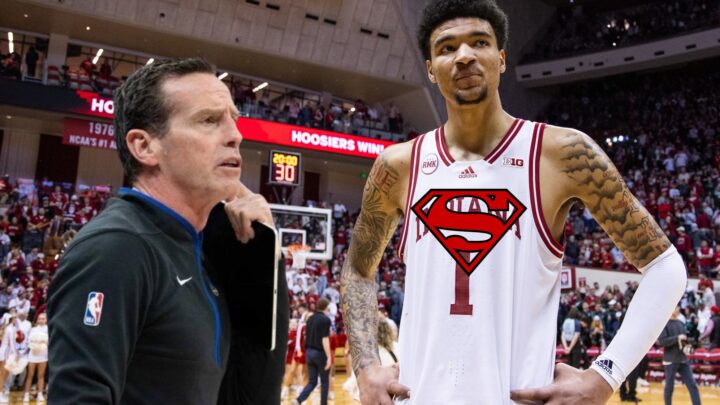
This happened more swiftly than I thought it would. The morning after the Cavs finished their season with a loss to the also-lowly Bobcats, Byron Scott is jobless. You know the story: three straight years deep in the lottery, rumors of locker room dissent, lots of looks similar to the one pictured above, where Scott just sort of peered out over the court as if it were an ocean, with a look of peevishness or bemusement.

There’s a sad impotency to ineffectual coaching that’s unique to the profession. The guy in a suit on the sidelines seems as if he might as well be a hundred miles away from the court. Players screw up. Not that they mean to screw up and not that the coach wants them to screw up, but they make mistakes. Over and over again. Maybe they stop listening to the guy in a suit on the sidelines because they’re frustrated or feel he’s not helping. A fissure widens. The coach’s control is revealed to be highly contingent.

There has been a lot of talk over the past few weeks that the Cavs need a firebrand who can whip the team into shape—barge through the locker room door imperiously and tell Kyrie Irving that, son, on this team we play with maximum effort. This is a gross, paternalistic strain of fandom—informed by the notion that these players in some way belong to us; they should be ideal actors because, dammit, we pay for their salaries. I think we should all do our best to avoid being that type of fan, especially in terms of this now-active coaching search. Irving will improve or stagnate according to his will; all a coach can do is advise him. You can tell all-stars what to do, but it’s up to them to listen. The Cavs should find someone who can speak to Irving, help him grow into the leadership role he needs to occupy, and not someone who will try to break him, because he probably won’t break.

I don’t know why Scott was fired, specifically, though I have a hard time believing all the losing was the primary reason. This team started the season with no bench and sub-par starters at three positions. Then Andy Varejao went down. Tristan Thompson and Dion Waiters improved markedly. Chris Grant poached a respectable bench unit from salary-dumping Memphis and Washington’s scrap heap. Then more injuries. I find it hard to believe Scott was expected to do significantly better than he did, record-wise, though the record is abysmal. Coincidentally, it could land the Cavs at the very top of this upcoming draft. From what I know of Grant, he’s a pragmatist who looks long-term while keeping himself firmly rooted in the present, so even if the Cavs lost, say, ten or fifteen more games than he thought they would this season, he’ll take the high draft pick and move forward.

What I’m more inclined to believe is Scott was fired for reasons less apparent in the standings and more apparent on the court: the puzzling substitutions patterns, the lack of ingenuity on offense (especially down the stretch), the damn high-pressure defensive system that was at least partially to blame for the Cavs’ historically bad opponent shooting percentages over the past three seasons. Perhaps this group of players was too young, too disparate to achieve respectability, but Scott could never assemble them in a way where it became easy to see where the future might lead. If the rumors are true, the players might have been divided as to whether he knew what he was doing. As of this morning, I’m certain the Cavs have talent, but I’m uncertain how that talent fits together and how each players’ individual skills can best serve the team’s success. A great coach is a great sense-maker, and this team is still gibberish in motion.

I’m sure the Cavs have a list, but I wonder who will want this job and the sort of work it’s going to entail. Surely, there are more than a few out-of-work head coaches and ambitious assistants who see a young team with promise, but it’s going to take a lot of effort—and some very specific expertise—to turn this team into a winner over the next few years. C:TB’s Nate Smith has been compiling a list over the past few weeks, and he’ll be hitting you with the a batch of possible candidates tomorrow morning.

At any rate, farewell Byron Scott. Whether you did the job well and got unlucky or did the job poorly and rightfully got the boot, enduring three seasons of rough basketball isn’t good for the psyche—I know this because I endured it, too, but I’m, at the very least, a wholly inculpable fan. I’m sure you’ll catch on somewhere else. Here’s to better days for both of us.

Amateur Documentarians

Sunday, April 14th, 2013

As a Cavs fan, what I want more than anything, and what I probably don’t deserve, is access to the inner workings of the organization: its front office, its locker room, its phone lines. A few months ago, on Slate’s Hang Up and Listen podcast, Stan Van Gundy complained the NBA forces teams to give the media too much useless access. I’m paraphrasing here, but Van Gundy said that on a game day, the head coach meets with the media four or five times—pre-walkthrough, post-walkthrough, pre-game, in-game, post-game—and most of those times, the coach really has nothing to say to them. What new quotes can you offer your team’s newspaper writers and bloggers when you just talked to them two hours ago? “Well Jim, since last we spoke, the team has played a few games of Mario Kart, gotten really into friendship bracelets, and staged a low-rent production of ‘Othello.’ Oh, and Tyler Zeller has converted to Tengriism. I continue to think the Celtics will be a tough opponent.”

It’s probably unpleasant for everyone involved to rephrase nothing five times or to have to spin nothing into a column that won’t read like sand tastes. I’m not imagining that excruciating kind of access, but something more substantive and therefore unrealistic: fly-on-the-wall type stuff. I’m curious how effectively and how much the front office communicates with the coaching staff, the type of instruction Byron Scott gives his players in practice, how hands-on Dan Gilbert is on draft day or during free agency. I would expect most of this stuff to be minutiae: front office drones clicking around Synergy, Scott yelling at Dion Waiters about a botched defensive rotation, Alonzo Gee and Boobie Gibson comparing ink. I would just like to know how the whole machine operates, and which parts are hopelessly corroded.

It would make this whole fandom endeavor, if not necessarily happier (it could turn out the Cavs are incredibly dysfunctional), then less suspenseful. I could do with a modicum of certainty as to what this team is working with and where it’s going after three years spent in the deep space of a slow rebuild. I’m not uneasy because I think the team is on the verge of failure; I’m uneasy because this sort of thing—tearing down and remaking and not being consulted about it—inspires unease.

But here we are. The Cavs, aside from a decent run of health and form in February, were pretty bad. Of course, “bad” is reductive. The team improved only marginally in the win column, but then this isn’t a team so much as it is a collection of bodies auditioning to play for an actual team—one that makes sense positionally and doesn’t get blown out by lottery teams—that will exist in the near future. Through narrow prisms, hope is visible: Tristan Thompson nearly averaged a double-double, when at this point last year he was playing basketball as if being constantly pelted with invisible water balloons. Dion Waiters curbed his penchant for step-back 19-footers and learned the free throw line is his friend. Kyrie Irving is Kyrie Irving, though the Cavs’ equipment staff might consider fashioning some sort of bubblewrap armsleeve to keep the young star preserved. There are other reasons for hope, maybe. People disagree about them. It gets loud and stupid. We’re moving on.

Because we only get glimpses into how the team functions, we can’t get the answers we want most—whether Scott will be back next year, Gilbert’s level of trust in Chris Grant, how the players feel about the direction of the team—and so have trouble prognosticating or rendering judgments that don’t feel woefully underinformed. Want my full analysis of the Scott situation? He has the comportment of a consternated waterbed salesman, puzzled as to why his “sleep solutions” aren’t moving as they should, and I’m not nuts about my favorite team being coached by a man who, in the fantastical one-act plays that happen in my head, is kind of a doof. I don’t like the faces dude makes, is more or less my reason for being okay with his prospective firing. There are other factors to consider, certainly, but I have a hard time knowing whether they’re his fault or not—do we blame him for Irving’s lack of interest in defense or is that someone else’s failure? I just know he’s the head coach, and he’s the guy with whom fault lies when the team makes like a street-side fruit stand in a chase scene. So my take on Scott’s fate is based on the half-bemused, half-ponderous look he affects when the team gets down by fifteen. It’s about as useful as any of the other information I have.

Which is why I have a hard time claiming with any conviction that the Cavs should fire him. What I understand just as incompletely but feel more comfortable commenting on is Chris Grant’s tenure as general manager. I know being an NBA GM entails a lot more than just making personnel moves (though, quick: ask me to delineate them before I dive out this window), but that’s ultimately what determines how we perceive the job they do.

Here’s a GM’s role and responsibilities, in handy narrative form: you—you’re an NBA owner in this situation; enjoy your party yacht—put your faith and money in a person to build what fans and broadcasters will, employing mildly unnerving corporate-speak, call “the foundation for success”: that is, you count on him to draft young talent, find someone to coach ‘em up, and perhaps make the odd off-brand free agent signing. You then, after three or four years, take stock of the situation. You’ve made your bed at this point—unless you want to trade away a bunch of players in their early 20s and start over again (and sell that plan to your anxious fanbase), you have to roll with the strategy your GM has half-implemented—but you can correct course slightly and decide to part ways with whoever drafted Jonny Flynn or thought Avery Johnson was much of anything besides loquacious because you’re better off hiring a GM that’s actually just a speak-and-spell with a picture of Danny Ferry’s face taped over the front of it than someone who believes in Avery Johnson.

Let’s say the rebuild process seems to be on the uptick. You dole out a contract extension, then hope the person you trusted to evaluate lottery-caliber young talent and find the coaching staff to develop that talent is also up to a task that’s not altogether similar: paying the right free agents the right amount of money, knowing when to flip an asset at peak value, and scrounging the middle and back end of the first round for rotation-quality prospects. Then you get old, eventually die, everyone who has ever met you dies, and, much later, the sun explodes.

I’m simplifying here, but that’s sort of the point: this is how I think general manager-dom works, and the limited information I have causes me to conceive of it that way. I’ll spare you the graf where I more or less slap grades on Chris Grant’s draft picks while comparing Tyler Zeller to a mop, but I think the rebuild is going about as well as one could hope, which is to say a bunch of dudes in their early 20s are running around stupidly and brilliantly; defensive technique is ritually murdered; I’m talking myself into Shaun Livingston. As a fan, I’m fatigued and not a little bit cranky, but as a rational being, I get that this pathetic outfit could soon grow into something watchable, even exciting.

We’re at what feels like the midpoint of the scenario I’ve laid out above. After three years of bottoming out and amassing good-at-basketball 20-year-olds—intellectual honesty alert!—I’m starting to resent having to watch this team three times a week and because of that am going to say the Cavs will finally make an earnest run at the playoffs in 2013-14. Plus, LeBron James is going to be a free agent next summer and a young team on the rise is a lot more enticing than a young team on the oh dear god C.J Miles just attempted to split a double team.

Here’s the part where I call next season a fulcrum and all the hypothetical good things happen. I think better of this because it feels lazy and disingenuous. Paragraph break.

I get the sensation watching this team that I imagine I would get watching raw footage from an incomplete documentary. Just interviews that go nowhere and the outsides of hotels and a bird landing on a statue and, interspersed, a few moments that vibrate, but then a lady talks in circles about her son for eight minutes, and I’m once again disoriented but mostly bored. I want the footage to tell me a story, but it doesn’t and I can only barely see what the story would be anyway because I’m not Errol Morris or Claude Lanzmann, who know a lot of things—most of them probably mundane and inside baseball-y—about how to tell a story using film. Plus they know why they record the things they record. They can see schematics and skeletons where I see only disjointed images.

I observe the Cavs, disoriented but mostly bored, trying to figure out what they are in the first place and what they can become. What’s missing, what needs to go away. I’m doing it without Chris Grant’s expertise or his extensive knowledge of the team’s inner workings. All I know is that, in the end, the Cavs are supposed to be good. This is a useless thing to know and only fosters anxiety. I find myself carving out time and psychic energy to weigh the pros and cons of resigning Mo Speights, which is as good an example that sports fandom is a ridiculous endeavor as any other.

All this vexation—over wanting to know stuff, over not knowing stuff—is at least something to do and proof enough that three years of excruciating basketball can’t kill whatever arbitrary but entirely real investment I have in this team, which I want to be entertaining, to surprise me, to feel proud of if and when they crawl out of their dismal crater. I’m still watching games, though more as source material for whimsy than anything. I think about Kyrie Irving’s facial hair in a way that he would probably find creepy, and I’ve drafted questions—mostly about pork and the eight movies BET runs on Sunday afternoons—for a Dion Waiters interview that will never happen. I’m not sure I’ve absorbed any of the games I’ve watched since mid-March, but they have happened to me. I know this because of all the books I haven’t read.

My analogy is flawed: even the most devoted cinéastes among us probably wouldn’t bother to endure hundreds of formless, meandering hours of raw documentary footage. If you’re a particularly masochistic Cavs fan, over the past three years, you have watched about 600-plus hours of intermittently thrilling but mostly awful basketball. Because your idiot heart wouldn’t let you do anything else. You’ve perhaps made something like sense out of those hours, but it’s the sort of sense that grows from too little sleep and a desire to feel anything but dull pangs. Maybe you’re like me and constantly, sort of insufferably kvetch over what you don’t know and all the unhelpful research you’ve compiled. You do this because you’re something like an amateur documentarian, but not exactly. You’re a fan, however better or worse that may be.

Lessons from the Bench

Friday, March 29th, 2013

The Cavs core contains: Kyrie Irving – Dion Waiters – Tristan Thompson – Tyler Zeller

All four members of the core were selected with first round picks in the last two drafts.  It’s reasonable to assume that at least 1 more draft pick will be added to the core this offseason.  The core remains solidified barring a major trade until at least 2015.

The Cavs bench can reasonably include: Shaun Livingston – Wayne Ellington  - Luke Walton –  Marreese Speights

The bench contains waiver-wire gem Shaun Livingston and 3 guys acquired in salary dumps.  It’s easy to imagine the trades were more about the accompanying draft picks than anything else.  But then they started playing together, and the Cavs, perhaps buoyed by a less grueling schedule, suddenly looked like a decent team.  The fate of the bench, or the Herculoids as they’re known around here, is anybody’s guess.  Logic suggests Ellington will be back, and I think Speights will opt-out, making it highly unlikely he returns to the Cavs.  Walton and Livingston will be unrestricted free agents. [HoopsWorld]

I appreciate what you did with the bench. But are they gonna be around next year?

The core and the bench share a locker room, and not much else.  Consider some of the differences:

Age and Experience: Zeller is the adult of the core, and the other 3 could still be in college next season had they stayed.  Ellington and Speights are 3 and 4 year players and Livingston and Walton are certified veterans.

Offensive Approach: The core scores more than 20% of its points off turnovers, and scores almost 11% of its points in transition.  The bench generates about 15% of its points off turnovers, but only 6% in transition.  The core has the edge in points in the paint and plays at a faster pace.  Naturally, it is a more athletic ensemble and tries to leverage that athleticism on offense.  Armed with only that information, you might suppose the core is a more efficient offensive team.  But it’s the opposite.  The core has posted an offensive rating of 100.9, while the bench sits comfortably at 107.7.  For perspective, the Heat lead the NBA with an ORTG of 112.6 and the Wizards are last with a 99.9 mark.

Defensive Approach: The core generates a lot of turnovers.  At a rate of 16.4% of opponent possessions ending in turnovers, that’s good for 5th in the NBA.  Their opponent foul shot to field goal attempted ratio (FTA/FGA) is slightly better than league average so they aren’t playing Jerry Sloan defense in order to force the turnovers.  The core secures only 70.4% of opponent misses – which would be the worst mark in the NBA this season.   The bench generates a more modest 14.2% opponent turnover rate, sends teams to the line more often, and does a decent job blocking out offensive rebounders – securing 76.1% of missed shots (higher than any NBA team this season).  The core bites more on pump fakes and chases shooters off the three point line, whereas the bench tends to concede many more triple tries over cemented feet and outstretched arms.  The core gives up 7 threes a game at 43% while the bench gives up 9 threes a game at 37%.  The core really can’t stop anybody on defense and is often exposed on the perimeter during a pick and roll.  The D breaks down and the players are left scrambling after the ball handler the way pee-wee soccer teams play defense.  The bench does a slightly better job, often choosing to switch screens on the perimeter limiting the crippling bouts of 4 on 5 defense.  The bench is longer, and more fundamentally sound, making life more difficult on ball handlers.  The bench gives up 46% FG and 36% 3PFG which is below average, while the core gives up 50% FG and 43% 3PFG which is shockingly poor and would easily generate the worst eFG% in the NBA.

The situation may not be quite as dire as presented above.  The bench as categorized avoided much of the early season gauntlet and does get the benefit of playing more minutes against opponent 2nd stringers.  Still, they do many things better than the core.  As the youth movement comes of age there are lessons that they can learn from their elders.  I’ll highlight a few that I’ve noticed over the course of the season.

Let's teach these young bloods how a 2-man game works

1.) Movement without the ball

Here at CtB we’ve bemoaned offensive stagnation all season – specifically when Dion and Kyrie are the culprits.  Check out Kevin’s answer to question 1.  http://www.cavstheblog.com/?p=18025 Neither player seems willing to make defenses pay any attention when the other is in isolation.  The Herculoids are a great lesson in moving without the ball.  Few offensive possessions feature non-ball handlers clearing out and waiting for something to happen.  Ellington flashes to the corners and Livingston does a great job keeping defenses honest by constantly making sharp backdoor cuts when he doesn’t have the ball.  Luke Walton’s willingness to pass is the secret ingredient that keeps the other players hungry to find an opening.  Walton, Livingston, and Ellington all make better use of screens than their younger brethren and it creates a fluid offense that scores well in half-court sets.  This is something the core must improve upon if they are to compete in the playoffs.  Good defensive teams can make even the best isolation scorers inefficient in the half-court.  Think back to the 2008 Celtics against the Cavs.  The game slows down in the playoffs, defenses tighten, and offenses really need to move defenders from sideline to sideline to generate easy looks.

2.) Using individual moves to gain an advantage for teammates

It’s the black mark of a chucker, really.  The AI/Kobe/Melo syndrome. These players can get their shot off from anywhere on the court.  Iverson did it with his elite handle, Kobe does it with elite footwork and balance, and Melo does it with a nasty jab-step jumper and explosive first step.  But these guys are not natural facilitators.  When they start losing games questions often arise about how well they fit with their teammates.  And we all remember how Melo + AI worked out.  Contrast those prolific one-on-one scoring attacks with a team like the Spurs, where small advantages are leveraged to give other players much bigger ones.  The Cavs bench provides a nice example of this.  Walton and Livingston are the focal points again.  Both players, even with range limitations on their shot and below average athleticism, are superior to Irving and Waiters at creating seams for their teammates to score more easily.  Walton, despite shooting 29% on threes and sporting a career TS% below .500 gets so many defenders to bite on his deliberate pump fakes.  He uses that slight opening to take a dribble or two into the teeth and gets another defender to step up.  With 2 players out of position, the court is his canvas and he regularly finds Shaun Livingston moving into the open space for layups and uncontested mid-range Js.  These are skills the core really needs to hone.  For all of Kyrie’s prodigenous (first used here) talents, he is weak at passing out of double teams and exploiting the 3 on 4 defense that remains.  Waiters seems more willing to use his explosive first step to draw defenders and then dish off once the defense has collapsed – a welcome sign.  Overall, the creativity and willingness to pass needs to manifest after the initial defensive breakdown.  TT can afford to look for cutters as well when he makes his strong bull move across the lane.  He’s gotten better at creative counters to give himself angles around the basket.  However, when he gets pushed away from his sweet spot by a committed defense, he can survey for open perimeter shooters.  The bench scores 64% of it baskets off assists, compared to the core at 56% despite less dynamic offensive players.

3.) Decisiveness

One of the mysteries of the Cavaliers season is how a bunch of cast-offs could play so well together.  It’s never easy to integrate new players to an existing system.   But in this case, most variations of the Herculoids contained no more than 2 players that had ever played together.  And despite that, they seem supremely comfortable executing offense.  Some of this is due to the decisiveness of the personnel.  Watching Kyrie and Dion in isolation can be a lot like watching a cat stalk/attack its prey.  It might probe, it might play, it might pounce.  It’s hard to predict.  I’ve mentioned on numerous occasions how ineffective some of the picks set for Kyrie are, because he doesn’t really use them.  He generally plays with his defender using elite ball-handling and one on one moves, trying to get his defender to bite before finally creating the separation he needs to score.  But there’s a reason cats hunt alone.  The bench guys probably learned after the first practice that Luke Walton would always look for them to cut backdoor, that Mo Speights would rise up and shoot anything he got his hands on, that Shaun Livingston loves backing down smaller guards to collapse the defense and that Wayne Ellington would always find open space to fill around the perimeter.  Making crisp, decisive moves and forcing the defense to react to that is an effective way for players to get comfortable playing with each other.  All season I’ve commented that the starters don’t seem to be more than the sum of their parts – sometimes even less than that.  The decisiveness with which the bench approaches the offense has made it easy for strangers to develop chemistry quickly.

No hesitation.

4.) Composure

The Cavs core has played considerably worse this season on the road.  The offensive rating in road games is a putrid 98.6.  It is also much worse in second halves: 98.0 versus 103.8 in the first half.  The bench exhibits the opposite on both counts: playing better on the road and in second halves.  Part of the reason for the Cavs offensive woes is that they don’t generate easy baskets in the half court unless individuals catch fire.  When defenses ramp up the intensity, the Cavs core often folds.  At the other end of the court, the pick and roll devastates the core’s perimeter defense – often on account of poor anticipation by Kyrie, and slow lateral quickness by Zeller trying to stop the penetration.  The bench production seems to be less effected by place and time.

5.) Toughness

The Cavs are not a tough team, but the addition of Livingston and Speights provided examples of both a mentally tough and a physically tough player.  Watching Livingston direct the defense and constantly fight until the end of so many heart-wrenching losses should motivate the young guys.  That sort of leadership and attitude is something that could elevate Kyrie from all-star to generational superstar.  The success of the team is going to hinge on Kyrie’s commitment.  If he’s content to take plays/quarters/games off, particularly at the defensive end, so will the rest of the UncleDrew army.  Waiters needs to stay mentally tough as well.  He has been resilient this year, and quieted concerns about his character and coachability.  But he needs to stay in attack mode even when he’s not getting the better end of whistles.  I’ve come prepared to help. Zeller can learn a thing or two from Speights.  Maybe not on defense where Speights has been poor, but noting instead how he throws his body around and punishes defenders under the basket.  For a guy that’s a bit undersized and has a rep for chucking – he gets to the line quite a bit and has really honed his jumper – something Zeller needs to emulate.  He also has a bit of a mean streak – which many of the Cavs could experiment with from time to time when situation demands it.

There are lots of opportunities for the Cavs core to assimilate some of the traits and skill sets of that bench guys that give them a breather every night.  Hopefully they are taking notes.

1 through 5

Friday, March 1st, 2013

Five Cavs questions for the writers – all in one place.


Question 1: Discuss the Kyrie/Dion on-court chemistry and how the Cavs should build an offense around these two.

Mallory: I covered this VERY thoroughly in the podcast but my basic gist is that both need to look to attack.  Ideally, Kyrie would look, off a screen, for a jump shot – if it’s not there, he’d dish to Andy/TT off a PnR or Dion who would attack the rim and either finish or, if the D collapses, dish out to an open wing at the corner, or an open Kyrie driving to the rim (Or, Speights/Zeller for a jumper) – the reason this works so nicely is Waiters is excellent at passing out of a drive.  The only issue here is Kyrie doesn’t move well without the ball in his hands.

Dani: There have been some notable exceptions (there’s at least one nice drive and kick play a game, for example), but overall the on-court chemistry between Dion Waiters and Kyrie Irving has been severely lacking. Dion hasn’t really figured out any off-ball moved or cuts yet, and combined with the fact that Kyrie is occasionally a reluctant passer, what often results is a stunted isolation for Kyrie at the end of the shot clock, while Dion sulks thirty feet from the hoop. I would love for Byron Scott to initiate a lot more movement for the Cavaliers in general, and a lot of that should involve the backcourt. For example, a pick and roll starting with Kyrie and Tyler Zeller could be helped immensely if another player set a screen for Dion to dive to the rim. Zeller so often pops outside for a jumper that there should be more space in the paint for a cutting Dion to finish. As for an overall offensive gameplan, I want all Cavs coaches and players to watch extensive tape on the Rockets offense. James Harden and Jeremy Lin pilot one of the best offenses in the NBA, and there’s no reason the Cavs couldn’t reach similar heights in a similar scheme (lots and lots of three-pointers)with Dion and Kyrie.

Kevin: Undoubtedly, it needs work, but they are 20 and 21.  Too many times off the ball, Dion drifts 30 or 40 feet from the basket, which can be maddening.  The team plays four-on-five…or maybe one-on-five, if Kyrie decides to do it himself.  This is definitely in contrast to watching the bench orchestrate a superior team offense with lesser talent.  Dion needs to navigate better away from the ball.  An imaginary line needs drawn 26 feet from the basket, that he can not cross in the half-court.  He needs to learn proper timing to cut when Kyrie drives  Both players need to more frequently dive to the corner when dribble penetration occur.  Ultimately, the team has to start looking like they call and run plays other than pick & roll when the starters are in.  I think Dion should work on some post offense.  Finally, Kyrie must initiate more offense for his teammates; with how skillfully he breaks down defenses, 5 assists a night has to get higher as he matures.

Nate: The Cavs are one of many teams in the NBA that are going long stretches with two guards on the floor at the same time that can initiate the offense: Houston, San Antonio, Charlotte, Brooklyn, Sacramento, Minnesota, etc.  Dion, Kyrie and the brain trust need to sit down and watch how these other teams do it.  One thing that needs to happen is that Dion and the rest of the team need to get better at running fast breaks.  The Cavs consistently waste three on two breaks by leaking Gee or Waiters to the corner instead of filling the lanes on the primary break.  Waiters needs to work on being the finisher on the break and not just the ball handler — Kyrie too.  Finally, movement needs to happen.  Teams have figured out the double-iso I talked about in the Heat game.  Kyrie is drawing so much attention in the fourth quarter that movement out of that set would help immensely.  So I drew up a set Cavaliers could use.  Click here to see it slowed down.

Coach Nate's crunch time set for KI and DW.

Tom: It’s lacking, but I don’t think it’s a talent/skill set issue, and thus, it is correctable.  Kyrie is a generational wunderkind on offense, so I’m not going to put the onus on him to change his stripes, he just needs to be more willing to move without the ball after he gives it up.  Dion is going to have to start playing like Gerald Wallace, though (minus the injuries).  He should be in attack mode at all times.  When Kyrie is vaporizing opponent ligaments, Dion needs to be curling around behind him filling the now-open space or crashing towards the hoop for a weakside bucket.  Dion has shown a lot of growth already, especially in his half-court approach – I have confidence that with solid coaching, they will be devastating together.

Question 2: There was a lot of talk very early about Dion Waiters.  Now that the sample size has grown, how have your perceptions changed on him/his potential?

Mallory: The question was never whether Dion had potential – he always had.  The question was whether or not he could cut down on stupid jumpers/attack the rim more often/stay focused on D.  Recently he’s done all three of those things.  Even more, Waiters has shown a knack for finding open men while making his way to the rim, which has resulted in a LOT of open jumpers for the likes of Ellington/Miles/etc.  Gotta love that!

All that being said, we should still, as always, proceed with caution.  As Kevin alluded to in his of the Toronto game, TT has, after his sudden Jan/Feb improvements, seen a recent drop off of his offensive production/efficiency.  This is likely because 1. He was on a hot streak, 2. Offenses have figured him out.  It’s not like some of us didn’t see either of those things coming, and it’s not as though he’s suddenly bad (he’s still playing well above average, and will likely continue to get better), but it’s worth noting because I could easily see something similar happening to Dion.  Right now he’s feeling it – he’s attacking the rim more, taking better shots, and even hitting some of his sillier ones.  While it’s plausible he’s suddenly found himself, it’s more likely he’s going through his own hot streak and that, eventually, opponents will figure him out.  The key is for him to continue to attack the rim and work on taking smarter shots, and eventually finding a way to co-exist with Kyrie.  If he can do that, he’ll replace any drop off in his streakier production with a more balanced game, leading to even greater improvement. Don’t get me wrong, though.  I love what I’m seeing from him.  A guy who can play fast/shoot/attack the rim/defend/see the court is always welcome on my team.

Dani: I started off the season relatively lukewarm on Dion Waiters. At the time, I felt as if the Cavs had panicked when the Bobcats deal fell apart, and reached for a shooting guard. And when he came to Summer Leauge out of shape, my fears were heightened. Then there was the awful shot selection of the beginning of the season; despite a few hot shooting nights, off balance 20-footers were all too common. He was also awful at the rim. But as of late, Dion has really stepped it up. He’s much more efficient at the rim, drives the ball a LOT more than he did at the beginning of the year, and has mostly stayed away from the wild bouts of fadeaway madness. One thing that has remained constant all year is his passing ability. Waiters is a very talented facilitator when he feels like it, and his kick-outs to the corner are beautiful (thank you, Wayne Ellington!). The only player from this year’s draft who is inarguably more valuable than Dion, in my opinion, is Andre Drummond. Dion Waiters has been a revelation recently. At the beginning of the year, I was thinking Monta Ellis. Now I’m thinking Dwyane Wade.

Kevin: I always liked Dion.  To some extent, my perceptions have not changed, they instead look more realistic.  I do less daily teeth-gnashing certainly.  His February, averaging 20 efficient points with 4 assists per 36 minutes, is what I hope he can do every night in a couple of years.  He needs to stay aggressive on offense, focus on team defense, never dribble aimlessly, and stay engaged in the half-court without the ball.  With his full potential reached, the Cavs will employ one-heck of a backcourt.

Nate: The sky is the limit for Dion.  He obviously has a body, handle, shot, and defensive pursuit to be a very effect hybrid/2 Guard in the NBA.  Additionally, his passing, floor vision, and ability to run an offense, especially in the last two games are a revelation.  His only limitation is his off the ball defense, below average rebounding, and his focus.  He lets the refs and events on the floor take him out of his game too often.  These are rookie mistakes, and.  As long as he can avoid falling in love with 22 footers early in the shot clock, he’ll be fine.  In looking at the early reactions to the draft pick, the buzz was that Waiters and Anthony Davis were the only players in the draft with the ability to be superstars.  Lillard could possibly be added to that list, but I’ve seen nothing that makes me think that analysis is off.  The Cavaliers swung for the fences with Dion Waiters, and it doesn’t look like the wind off Lake Erie is knocking down the deep fly ball yet.

Tom: Of course all I needed was Chad Ford to drop the Wade comparisons a few times and I was sold that Waiters was the guy to take.  Yes, I wanted MKG, but when he was taken I wanted Waiters.  My perceptions of Waiters that have changed the most are about his professionalism.  There were character-related concerns his freshman year at Syracuse and it rubbed me the wrong way that he didn’t work out before the draft and came to camp out-of-shape.  But he has impressed upon me that he uses adversity in a positive way.  When he was benched for poor play (mind-numbing shot selection and trouble finishing) he didn’t sulk.  He came off the bench in attack mode and got to the free throw line.  This approach to the game is the only way he can ever come close to sniffing the Wade comparisons – and he’s embracing it.  As far as his talent – I think he has shown all-star potential.  He plays a little more below-the-rim than I had hoped, but I think this is because he leaves his feet very early when driving to the hoop.  He’s not going to be dunking over people ala Wade, but 2 points is 2 points.  Everyone from Byron Scott down to us lowly writers need to constantly remind Dion:  “REMEMBER WHO YOU ARE” so he can elevate to the proper place in the circle of life the restricted area.

Question 3: The Cavs are winning some games and obviously the bench has been a revelation, but how much credit has the coaching staff earned for the recent success?

Mallory: I think the coaching staff certainly deserves some credit – the obvious improvements from TT and Dion are clearly a major part of the team’s recent success, and couldn’t have been achieved without a patient, smart coaching staff.  But the real winner in the Cavaliers’ improvement is obviously Chris Grant.  Many of us clamored for a better bench, Grant finally brought that in and, surprise surprise, they’re suddenly winning games.  I applaud Scott for using his bench well, especially Luke Walton, who many of us (myself included) thought was a corpse.  But at the same time, using guys like Speights and Ellington was a no brainer over what the team was throwing out there before – really, most anything would’ve been an upgrade.

Dani: Byron Scott certainly deserves a lot of credit for the bench’s success. Initially, we all called for Luke Walton’s head, and complained about his ridiculous (to us) amounts of PT. Fast forward a few months, however, and Scott’s vision of Waltonia has become evident. The 32 year-old has played a huge role in several wins recently, playing hard and showing off outstanding court vision. However, most of the credit for the Herculoids (@Nate)  goes to Chris Grant, for turning Jon Leuer into Marreese Speights and Wayne Ellington. Both players have been great, and provided the floor spacing every offensive unit sorely needs. Also, Grant’s Shaun Livingston pickup was one of the savviest front office moves of the year, in all of the NBA. He’s been fantastic as a floor general, and must have one of the best midrange turnaround jumpers in the league.

Kevin: Certainly some of the recent success is due to Tristan’s sterling January and Dion’s fantastic February, and the improvements from them definitely should proffer credit to the coaches.  Clearly, Tristan absorbed lessons-taught about post offense and Dion heeded advice to attack at that end.  The other huge part of the winning is the bench.  In that case, I think much of the credit goes to the players, or Chris Grant.  The bench unit is now all veteran guys that appear to have an intrinsic idea of how to play with each other.  After Livingston, Ellington and Speights came on board early in 2013, everything immediately clicked.  And Luke Walton deserves all the credit for Luke Walton…keep believing in yourself, man.

Nate: I give Byron Scott a lot of credit for sticking with Luke Walton.  I will eat crow and say that I didn’t ever think he could be as effective as he’s been, and I’m super thrilled that his back is healed, and he’s capable of playing at a high level again.  There was a lot of talk that he’d never play again.  Kudos to the coaching staff too.  I was ready to bury them for a while, but they were trying to make chicken salad out of chicken shiitake mushrooms.  They also deserve applause for the way they’ve seamlessly integrated the new additions.  And Chris Grant and Dan Gilbert’s money: great job on bringing in those new additions: smart players with good NBA skill sets.  Now the challenge is to get better at winning and making adjustments in the fourth quarter.

Tom: After being underwhelmed with the in-game coaching, rotations, adjustments, and the general lack of urgency, I am more at ease these days, as I think the Cavs coaching staff is turning the corner.  I’ve started to notice little things: Cavs getting more 2 for 1s, using fouls to give, better inbounding plays, defensive adjustments, and just players approaching each game like they actually paid attention to scouting reports.  Since the all-star break I have noticed the Cavs actively trying things on defense to take away opponent strengths.  It’s not really effective yet, but it’s a necessary first step.  Also, it’s easy to say that the Cavs had huge upgrades in talent, but how honest is that?  When I bring up Greg Oden there are people that immediately freak out and say “He’ll never play again”.  But we all expected Shaun Livingston to be hitting his head on the rim throwing down reverse dunks…and after being cut from the Wizards?  Right.  And my initial reaction to the now herculoidian trade was: “well, the draft pick might be nice, but I really thought we should have played Leuer more…”.  So yeah, I’m gonna give the coaches the benefit of the doubt on this one.  Well done, guys.

Question 4: Are you most surprised with the outstanding play of Luke Walton, Shaun Livingston, or Wayne Ellington? How has their play diverged from your expectations if you had any expectations in, say, January.

Mallory: First, let me say, as I have many times, that I’ve irrationally loved Livingston’s game for a while.  If anything, I’ve always overrated the guy, so it’s not surprising to me he’s become a leader.  Now, knowing that, this is still a tough question to answer.  The obvious reply is Walton, because, like I noted above, we all pretty much assumed Walton was broken down.  He’s clearly not, and has, like Livingston, embraced a major leadership role on this team. (Quick aside, I vaguely remember a discussion between myself and a bunch of commenters about how, more than anything, this team needed to trade for some vet leaders.  Who would’ve thought WALTON would turn out to be the answer?)  The problem with quickly saying ‘Walton’ is, in honesty, I had no idea Ellington could play at such a high level.  Tom covered it pretty thoroughly – Ellington is exceeding all expectations on both O and D, and has become a major spark off the bench.  We all knew he was a knock-down three point shooter, and that his ability to do so would be a perfect fit for this team, but who would’ve thought he’d be able to do so much else?  So, while my short answer is Walton, my long answer is BOTH.

Dani: I wrote about Walton and Livingston above, so I’ll focus on Ellington. Coming in from Memphis, Ellington was known as a sort-of effective spot-up shooter, and little else. He played very limited minutes for the Grizzlies. However, he has been very good on the Cavaliers so far, performing at a level he has never even approached in his career, averaging career highs in percentages across the board, and sporting a PER that is his career’s best by a wide mile. Now, that could mean one of two things. Either he has been revitalized by more minutes and increased opportunity in a new team, or he’s simply overachieving, and likely to fall back to Earth any day now. I tend to lean towards the former, if only because I’m a hopeless optimist; I see Ellington as a perfect 3-and-D guy, and a significant piece of the Cavs future.

Kevin: Absolutely, Luke Walton.  There is no denying that he was really, really bad early this season, and probably has been for several years.  Through the early part of this season, his per-36 minute numbers were something like 6, 4 & 4 on 35% shooting.  His defense was sieve-like; he generally looked out-of-place and not athletic enough to complete.  I wrote an article several weeks ago outlining how miserable his performance had been going back to 2008 – 2009.  He piled up 40 assists and 8 turnovers in February, and avoided being a complete defensive liability, for what may have been the NBA’s “Bench of the Month”.  That sounds crazy, but after Wednesday, the Cavs have outscored opponents by 15 points per 100 possessions when Wayne Ellington plays, with a 124 offensive rating.  That is ridiculous.

Nate: Was Luke Skywalker surprised that Vader was his father?  Was America surprised at the end of the Sixth Sense?  Was Karl Rove surprised on the second Tuesday of last November?  Yes.  I am surprised that Luke Walton is a quality NBA basketball player again.  The fact that he’s so effective playing so many minutes as point power forward?  …even more surprising.  But runner up?  I had no idea that Wayne Ellington was this good.  His advanced stats are ridiculous.  A +7.3 simple rating?  That’s borderline elite.  That’s NBA 6th man of the year quality.

Tom: Well, what Walton is doing lately is saving this season from a fan-perspective.  But the thing is, while guys like Nate were trying to throw him birthday parties with triple-digit candles, I’ve thought all season that Walton’s presence on the court was a net positive from the perspective of: “this is how you play the game.”  Actually, at one time I called Walton the anti-Jamison.  He wasn’t talented enough to generate wins (as Jamison certainly was) but his approach to the game was correct and he could rub off on the young guys.  Then he started laying out to tip passes and hitting game winners and developing devastatingly fun 2-man games with every player on the team.  He has a surreal assist to turnover ratio lately, and his play is leading directly to wins – and it’s making this whole season a memorable one.  No one saw it coming.  But the guy whose actual production is just blowing me away is Ellington.  Man I hope he can keep it up.  And for my final magic trick I’ll say that if you’d have described all three scenarios (the play of Walton, Livingston, and Ellington) to me in November (before Walton posted a negative PER) my response would have been “Wait, you mean Shaun Livingston of the youtube video I refuse to watch?  He can walk?  And he still plays sports?  Really.”

Question 5: If you were Chris Grant, name a free agent you would pursue this offseason and justify the contract details.


Mallory: First off, I’d keep this team entirely intact.  I love this bench and think, as long as Ellington is ~$3.5 for a year (which he will be), Livingston is ~$2 mil a year for 2-3 years (which he should be) and Speights is $4.5-5 mil for 3 years or $5-6 mil for 2 years (which  he should be, and don’t say he’s not worth it – the guy is one of the top 10 bench scorers in the East, is a decent post defender, and plays with a crazy mean streak.  Those are ALL qualities a winning team can embrace) and Walton can be had for vet minimum (which, come on, he should be.  The guy just made 8 mil THIS YEAR.)   Throw in a 7th overall pick, and that leaves us with around $44 mil spent (give or take a few mil. – doing quick math here)  The cap is $58 mil, meaning the Cavs have $14 mil to spend/not spend on a player.  Really, there are two directions to go here.

Scenario1: If Cleveland drafts a Center, they need to figure out how to divide the time between TT/Andy/Zeller/Speights/Player X.  Realistically, Speights is probably the odd man out, though it’s a scary proposition to think of throwing him away when he’s so productive.  Zeller is probably the least productive, but also still has upside, so my bet is he sticks around.  Unless TT players 30 minutes, Andy plays 25, Zeller and Speights play 15, and Player X plays 11, which is possible, by the way, there’s just not enough time to go around.  If that happens, I’d really like to see the Cavs go after Andre Iguodala at 12-14 mil a year for 3 years.  I realize many of our readers are banking on the return of LeBron, but the truth is it’s silly to just assume he’ll return.  The man changes his mind on a daily basis – do you really want to stunt team progress for the guy who turned his back on the team and the city of Cleveland just a few years ago?  If it works out, great, but if they can snag Iguodala at what would be a reasonable rate, I’d do it in a heartbeat.  Iggy is a long, strong defender who, though struggling this year, has always been solid on O.  He passes well, rebounds well, does a ton of dirty work, and isn’t the slightest bit selfish.  There’s always a place on my team for a guy like that.  If they can do 15 mil a  year for 2 years with a team option, I’d do it in a heartbeat.

Scenario 2: The Cavs draft a young wing.  If that happens, the team is suddenly pretty evenly distributed, with a minor hole at center.  I know the consensus is that Andy plays better at the 4, but if Cleveland can get away with him playing at the 5, with Zeller backing him up, doesn’t the front court feel complete?  The only guy I’d consider signing is Greg Oden for 2 years guaranteed at 2 mil a year, with a third year team option.  If he blossoms, great, if not, we still have a front court complete for the next 2-3 years.

The thing is, I don’t see either of these scenarios happening.  It’s becoming clearer and clearer that the time has come to go full steam ahead. Cleveland has far too many assets/young guys on the team – we argue over the Speights/Ellingtons/Livingstons of the world, but really 3 years at 5 mil or two years at 3 mil aren’t going to hamper them badly – given the number of small contracts the team has, there’s a lot of flexibility on the roster.  What I would REALLY like to see happen is for Grant to go for a big trade.  Assuming he drafts a SF, Cleveland will have a complete starter-quality roster of Kyrie, Dion, TT, Andy, and player X.  The truth is, beyond Kyrie and to some degree Dion, most of these starters/subs are movable.  We love Tristan, but if you could trade him for Kevin Love, wouldn’t you?  That’s why I’d love to see the Cavs pull a blockbuster deal of Tristan, Zeller, picks (likely this year’s 1st), and some cap filler for Love.  The reason a team gets assets is to have the ability to pull off a trade like this – Tristan is a great young guy, but the likelihood that he turns into a player of Love’s level is doubtful.  That’s why, despite the fact that we love what Cleveland’s young nucleus looks like, it makes the most sense to grab a guy while they still can.  Otherwise the Cavs might, in a few years, be staring at a Harden for Kevin Martin/ec. scenario where, because of lack of money and roster space, they’re getting less value than they’re giving. I could see something similar happening with Dion, though I really like how his game has blossomed, or even with Andy.  But the fact remains that swapping a sum of youth/assets for one big prize makes the most sense to go to the next level.

Dani: Despite what many people have said and argued (well) about Paul Millsap on the Cavs, I don’t see it working out. Tristan Thompson isn’t really big enough to play center, as we all remember from last year. Anderson Varejao is best as a power forward, and Zeller isn’t really ready to start. At all. I also find it unlikely that Andre Iguodola opts out of $16.4 million dollars this year. But if he does, I would love to see the Cavs pick him up. Four years, $44 million? Perfect. If I’m Chris Grant, I actually stay away from Nikola Pekovic. He’s peaking right now, and someone is going to give him way too much money. Samuel Dalembert might be worth a few million dollars- the Cavs don’t have nearly enough centers on the roster. Tiago Splitter is actually my number one target for the Cavs this year, if Iguodola isn’t an option. He’s one of the most effective scoring centers in the league. The Cavs would  probably have to pay a little more than market value (given that this is Cleveland), but I think he’s well worth it.

Kevin: This is boring, but Livingston and Ellington.  Between the five starters, two more rookies, Andy, those two, and CJ Miles; the roster includes eleven players.  Maybe Walton comes back as a twelfth man, but I think “Patience in Free Agency” remains the theme this off-season.  Speaking of Andy, when he comes back next year, the team should limit him to 20 – 25 minutes per game, basically filling Speights’ minutes.  Can you imagine the second-unit, but with Andy instead of Marreese?  The passing and ball-moving raises to an even more exquisite level in that scenario, right?  I’m excited.  With growth from the youngsters, 20 minutes per night of Andy, and another decent draft, the Cavs should be strong next year, without a free agent splash.

Nate: Well, we all know now that the “plan” is to not tie too much money up long term before 2014.  With Tristan as tantalizing as he’s been, I don’t know if I want Cleveland to throw a ton of money at the power forward crop.  Al Jefferson is probably too expensive and too old, and I want to see this bench crew back at reasonable contracts.  So, I give you next year’s free agent: Mike Dunleavy.  Dunleavy can be 2013’s Luke Walton: he’ll be 33, but he is having a fantastic shooting year, with a 14.9 PER, shoots .459/.431/.813, is 6’9″, can play 3 positions, and is a perfect safety valve for Kyrie and Dion.  He will probably want to go to a contender, but overpaying him for 3-4 million a year for a 2 year deal with a team option on the 2nd year?  That would probably price him out of most other teams’ range.  He’s a solid veteran who would have no problem helping this team continue to learn to be pros.  Splashy?  No.  Effective?  Yes.

Tom: Wanted: Defense, athleticism, and effectiveness without the use of inflatable spheres.  Prior Work: NBA Small-Forward or Center.  Pay: 3-6 million per season.  Contract: 2 to 5 years.  Would someone please pass this along to: DeMarre Carroll from Utah (unrestricted) and Al-Farouq Aminu aka Dhalsim from Street Fighter now playing for New Orleans (team option).

I look forward to how you answer #3

Commentariat, how would you answer these?

Cavaliers Reset

Thursday, February 21st, 2013

Unsurprisingly, not much happened for the Cavaliers on trade deadline day. There were a few rumors about a possible Mo Speights-for-a-pick swap, but nothing concrete enough to get excited about. All is placid here at C:TB HQ. Kevin is conked out in an armchair, and Mallory’s half-heartedly trying to beat a difficult Super Meat Boy level. Cavs: The Cat is asleep by my feet as I type this. But before we join Kevin in dreamland, let’s examine what the Cavs have going forward, since we now know what the roster is going to look like for the rest of the season.

Starting Backcourt:

Kyrie Irving and Dion Waiters aren’t going anywhere. Saint Weirdo is in the first season of a four-year rookie deal, and Chris Grant will likely extend a max contract offer to Kyrie in the middle of next season that’ll make him a Cavalier until his mid-20s. The children are our future, etc.

Starting Frontcourt:

Alonzo Gee is on the books for $3.25M next year and has a $3.25M team option for the 2014-15 season. Hopefully, the Cavs will make a signing or draft selection that relegates him to the bench sooner rather than later. I think nearly every Cleveland fan has a soft spot in their heart for AG, but he isn’t much more than a decent substitute. After showing considerable growth in his first two seasons with the team, he’s revealing this season that he’s just not good enough to run with your average starting NBA wing.

After this breakout year, I feel terrific about Tristan Thompson as the Cavs’ starting power forward for the next decade. Like Waiters and Irving, he’s still on his rookie deal, though he obviously won’t get a max extension offer like Irving will, so it remains to be seen if the Cavs will lock him up long-term during next season or wait until he becomes a restricted free agent. At any rate, unless he gets a phenomenally stupid contract offer from another team in the summer of 2015, he’ll be a Cavalier alongside Kyrie and Dion for a long time.

Anderson Varejao’s future with the team is precarious, though perhaps not as precarious as it was a few months ago. Cavs fans have always seemed split down the middle on this issue, but I was in favor of trading Varejao before he got hurt, even if it meant doing so for eighty cents on the dollar. I’ve reformed my position, though: I think this last injury drove down his value to the point that the Cavs are better off rolling the dice that he’ll stay healthy than shipping him out for a pittance. Regardless of whether Varejao can stay healthy, the team needs to start grooming a future starting center. (Unless you think Tyler Zeller is that guy; I don’t think he is.) Wild Thing will be 31 by the start of next season, when the Cavs will pay him $9.1M. That’s a bargain if he plays his best for 70 games; it’s a sunk cost if he ends up sitting out two-thirds of the season again. If he does stay healthy, he also has a $9.8M team option for the 2014-15 season.

Rotation Players:

Tyler Zeller is a backup center. That’s a fine thing to be. You can do worse with the 18th pick in the draft. I look forward to a future in which T-Zell steps off the bench for 18 minutes a game, knocks down a couple open jumpers, draws a charge, and grabs a few rebounds. Watching him have to match up against starting NBA centers for 30 minutes every night is rough. I feel for him. He’s on a rookie deal, obviously, so he’ll be a cheap bench player for the Cavs through the 2015-16 season.

Marreese Speights has a player option he can pick up this summer that will pay him $4.5M next season, but the conventional wisdom dictates that he’ll probably turn that down to become an unrestricted free agent and guarantee himself more money. It’s hard to know what the Cavs will do with Speights now that they’ve elected not to flip him for an asset. Is keeping him an indication that they intend to sign him in the offseason or did they just get lowballed when shopping him? How you feel about Speights going forward probably hinges around what sort of contract he’s on. Is two years and $12M palatable? Is four years and $21M a deal-breaker? It all depends on how much you value a bench big with a nice jumper and a nasty streak.

The Wayne Ellington situation is less complicated. I don’t see much reason why the Cavs wouldn’t match any reasonable offer Ellington receives in restricted free agency. They could use a spot-up shooter off the bench, and as much as I would like Boobie Gibson to be that player, Ellington is a taller, less frequently injured version of Gibson. I think unless an opposing GM confuses Ellington for O.J. Mayo, Ellington will be in wine and gold for the next couple of seasons.

C.J. Miles will likely be back next season at $2.25M. Do you really want me to break down C.J. Miles? I refuse. You can’t make me. (Fine: he shoots too much, and I kind of hate him. Moving on.)

Shaun Livingston has been a revelation at the backup point guard spot. After picking through the scrap heap—Donald Sloan, Jeremy Pargo—it appears that Cavs have found their man. What I like best about Livingston is how well he complements the rest of the backcourt because of his versatility. He’s a nice defensive player who can guard multiple positions, and he’s happy to play off the ball or run the point. You can put him in three-guard lineups if you want. He just fits in well on this team, and he rarely makes mistakes. He’s like a guard version of Nick Collison, which is high praise. I hope the Cavs lock him up this offseason.

The Scrap Heap:

Omri Casspi is a restricted free agent but for whatever reason hasn’t been able to crack the rotation. (Okay, I’m being coy: he’s not very good, but the Cavs had the worst bench in the league before Speights and Ellington showed up.) I would imagine he’ll ply his trade elsewhere when the season’s over.

Everyone in Cleveland’s heart sings for Boobie Gibson, I’m sure. He’s overpaid at $4.5M this season simply because he can’t stay on the court. If he wants to sign a one-year or two-year deal at a discount, I’m all for it, but it’s hard to be optimistic about player who has a habit of missing big swaths of seasons.

Luke Walton, friend of Flemish Renaissance painter Pieter Breugel until Breugel passed away in 1569, is a free man after this season. If you put his brain in Andray Blatche’s body, he’d be a borderline all-star, but unfortunately Walton has the body of a particularly athletic gym teacher. I don’t know if he’ll try to prolong his NBA career (perhaps even with the Cavs), go to Europe, or retire, but I’ve noticed that he genuinely seems to get a kick out of playing with this young Cavs team.  If I were Byron Scott or Chris Grant, I would ask if he wants to take up a coaching role in the organization whenever he decides to stop playing basketball.

* * * * *

So that’s more or less where the Cavs stand heading into the final third of this season. The obvious holes are at the starting center and small forward slots, but you knew that. What do you think the Cavs should do to patch those deficiencies? What sort of price would you pay for Marreese Speights? Was Sartre right when he argued that a text is not a concrete object, but something produced only through a dialogue between reader and language? Answer in the form of a sonnet.

Human Confetti and Haunted Fans

Wednesday, February 6th, 2013

LeBron James might be headed back to Cleveland in the summer of 2014 if he and ownership can patch things up and the Cavs have enough cap space and if the team is any good and if the Mavs or Lakers or Knicks or whomever can’t make him a better offer and maybe if everything seems fine and Dwyane Wade ages gracefully, then LBJ will just stay kicking it in Miami with its speedboats and glitter and Kardashian-took beaches, where he can shoot more of those “casual superstar” Samsung commercials where he says things like “you guys” and “[unintelligible because of riotous group laughter] man!” while people smile at him as if they have been well-compensated to do so.

I’m not going to pretend not to be titillated or have lots of conflicting emotions about the prospect of LeBron moving back home and trying to win a couple more championships flanked by a core of young players that will hopefully, by the summer of 2014, be emanating some 2009-10 Thunder vibes, but I don’t plan on giving it a lot of thought between now, and, say, April of next year. The Cavs aren’t reliving their 2010-11 season. There’s stuff to pay attention to in the meantime: Tristan Thompson’s rapid offensive development, the Dion Waiters project, Kyrie Irving’s existence, etc.

What I’m more interested in is the way LeBron continues to haunt Cavs fans. Whatever he absconded with when he left for Miami is still absent in Cleveland. When Kyrie Irving admitted last week that he checked out of a lopsided defeat against the Pistons, a smallish group of Cavaliers fans panicked and took it as an indication that he already has one foot out the door. The logic of this is wonky—he lost his focus for an hour on a Friday night in Detroit, how can we ever trust him?—but it’s rooted in abandonment issues that still linger in the wake of LeBron’s departure. Cavs fans are so worried about getting burned again that they are constantly searching for slights as an excuse to indulge their neurotic nightmares of Kyrie Irving playing for the Lakers in a half-decade plus. There’s still love between player and fanbase—it’s impossible not to be exhilarated in the moments when Irving knifes to the hoop like a diving seabird—but it’s all wary affection.

Cleveland might never possess a player like they thought they possessed LeBron, and that’s probably healthy for all parties involved. The claim that we’re all rooting for laundry just because fans and players aren’t devoted to teams in the same way betrays an unwillingness to deal with anything but an ideal world. (And an ideal world for whom, exactly?) As if nearly all goodwill isn’t circumstantial. LeBron reminded Cavs fans that sometimes a fanbase ends up on the wrong side of a difficult decision. Surely, as foolish as The Decision was, the lower-case decision to leave a competitive Cavs team for an unprecedented star-centric project in Miami couldn’t have been easy, even from a pure basketball standpoint. Bron’s Northeast Ohio roots must have only complicated matters. James didn’t show any public vexation over his choice because his persona doesn’t allow him to be anything less than a bronze statue of himself, but it couldn’t have caused him an insignificant amount of pain to leave home. He left a lot behind, and I think he knows that, even if some of that knowledge has only come through after-the-fact introspection. The adoration that he threw back at Cleveland during his Cavs tenure was real, in other words. Even if it was overstated or fleeting or confused and even if the billboard was, in retrospect, a little much.

Which isn’t to say LBJ wasn’t a hypocrite and a jerk on his way out. He played up the whole native son angle for his first six years in Cleveland, then abruptly stopped mentioning it during his contract year. While his agent was booking him a flight to Miami, he lapsed into semantics: he’s from Akron, not Cleveland, and, it turns out, that’s an important distinction that he had literally never made before he signed with the Heat. He was effectively a Clevelander until the moment it was inconvenient to be one. His emotional dishonesty, I think, is what bothered me the most, but then world-devouring brands tend to speak out of both sides of their mouths.

It’s too early in Kyrie Irving’s career to know whether or not he’ll agree to let Nike light him all sexy and posit his game as evidence of a greater power and its love for us, though he probably will, but we can thank whatever deity Adidas is comparing Derrick Rose to this week that Irving is from New Jersey and won’t participate in any ads in which he claims to be an embodiment of the city whose team he plays for. No one will let that happen again. For what it’s worth, I’m happy with where Irving’s persona is at right now—he’s a fun-to-watch youngster with a moderate goofy streak. I’m glad he’s not yet a world-devouring brand, and we haven’t yet listened to him recite aspirational copy over a sepia-tone closeup of his muscles moving in slow-motion as he bursts toward a solitary hoop. Bring on Uncle Drew. Those ads have some whimsy, at least.

So why are some of us searching for reasons to mistrust this pupating superstar? If you can’t watch Irving without thinking, when everything gets quiet, “Am I going to hate this guy one day?” then you took the wrong lessons from the LeBron debacle. What we learned was to not allow an athlete or marketing machine to tell us that any athlete is pure. If you’re a Hawks fan, you probably like Al Horford a lot, but you don’t think of him as pure. Because that’s absurd. For whatever reason, when an athlete reaches a certain phylum of greatness, we start ascribing traits to them that can’t possibly be true. LeBron was held up as a gladiator and a prophet and, it turns out, he is actually just a basketball player. A brilliant one who gave Cavaliers fans hundreds of masterpieces over seven years that were, on the whole, pretty enjoyable.

If you’re afraid Kyrie Irving is going to be LeBron James, Part Two, your fear is misguided because Irving is not LeBron and LeBron, even if he comes back to Cleveland, cannot re-become the machine-deity he and we and a team of marketing executives made him. The LeBron James—on a symbolic level—that almost single-handedly beat the eventual champion Celtics in the 2008 playoffs no longer exists. What he meant is not what he is—like a home can burn down in a fire and be ashes but still a home.

What resides in Cleveland, right now, is one of the very best scorers in the league. He’s 20 years old. He’s working on a beard right now, and I’m really excited to see it come to fruition in a couple of weeks. He’s on every NBA nerd’s must-watch list, and he plays for my favorite team. That picture up top! It’s terrific and makes me smile. I want to watch Irving and this young team grow and not worry about what’s going to happen in half a decade because I know the worst that could happen already has. Plus, I want to fully appreciate this second shot at a watching a superstar mature. I spent too much time holding my breath the first time around. A lot of us did. Have you ever watched a player who perfectly measures reverse lay-ins? Have you ever believed in physics less? Kyrie Irving isn’t a gladiator or a prophet. He never will be. He’s human confetti. He’s a Cavalier, for now. Good enough.

On Winning, Part I

Monday, February 4th, 2013

I’m the most insanely competitive person I know.  When I was 8, I locked my younger brother in a toy chest for beating me at Monopoly, and again for scoring on me in Colecovision Head to Head football.  The Dewer’s Supercubs winless T-ball season of 1984 was ruined when someone sick of losing punched a girl in the handshake line after the final game.  One winter in high school, I dived flopped across the hood of a 1984 Subaru GL Wagon to catch a street football touchdown.  This was the same winter I ran into a mailbox for the first time.

College wasn’t any better.  During intramural basketball, with an elusive win in sight, the Skankin’ Dave Hortons managed to foul out the jock dorm douche bag team’s fifth player with a minute left, and then go 1-10 from the free throw line to blow a 10 point lead and a 5-4 man advantage.  The stream of obscenities that graced the far reaches of UAF’s Student Rec Center after that loss, still cannot be reprinted, and I still think I owe them a basketball for the one I warped while punting it up to the running track.

At thirty, I almost ruined a high school graduation party by throwing a hand full of cards into my cousin’s face and calling him a (rhymes with “cluck”), for baiting me into bidding on a hand I had no business calling, and then euchring me.  I am no longer allowed to play the economics game Modern Art, after literally tearing my hair out.  My scalp’s never been the same.  And finally, I’ve taken a very long sabbatical from YMCA pickup basketball this year after a string of separated shoulders, knee surgeries, black eyes, and facial laceration scars.  All this insanity, leads one to wonder, after 30 years of competition, what is the point of it all?

Winners get to do what they want.  -Ricky Bobby, Talledega Nights

We’re a society obsessed with winning: from high school sports, to the World Series of Poker, to the Super Bowl, we value “winning.”  There’s very little sympathy for a team that plays well and loses.  The Buffalo Bills are not referred to as winners of four straight AFC Championships, they’re known as losers of four straight Super Bowls.  We define the verb “win” as such, (thanks reference.com):

1.  to finish first in a race, contest, or the like.
2.  to succeed by striving or effort: He applied for a scholarship and won.
3.  to gain the victory; overcome an adversary: The home team won.

verb (used with object)

4.  to succeed in reaching (a place, condition, etc.), especially by great effort: They won the shore through a violent storm.
5.  to get by effort, as through labor, competition, or conquest: He won his post after years of striving.
6.  to gain (a prize, fame, etc.).
7.  to be successful in (a game, battle, etc.).
8.  to make (one’s way), as by effort or ability.
“To Win” is not only the act of winning a contest or sport, but is the word for success in life: a result of the virtue of labor, effort, ability, serendipity, and in evangelical America, the favor of God.  What programmed us to be so obsessed with winning?  Certainly the drive to pass on one’s genetics to viable offspring and the competition for mates is a factor.  Ancient man must have had to compete through strength, muscle, and cunning to win a mate and dominate in society.  This fascinating paper by Allan Mazur elucidates some of that.

Male testosterone(T) varies in predicable ways both before and after competitive matches. First, athletes’ testosterone rises shortly before their matches, as if in anticipation of the competition (Campbell et al. 1988; Booth et al. 1989). This pre-competition boost may make the individual more willing to take risks (Daltzman and Zuckerman 1980) and improve coordination, cognitive performance, and concentration (Herrmann et al. 1976; Klaiber et al. 1971; Kemper 1990).

Second, for one or two hours after the match, T levels of winners are high relative to those of losers (Mazur and Lamb 1980; Elias 1981; Campbell et al. 1988; Booth et al. 1989;…). This rise in T following a win is associated with the subject’s elated mood. If the mood elevation is lessened because the subject has won by luck rather than through his own efforts, or because he does not regard the win as important, then the rise in T is lessened or does not occur at all (Mazur and Lamb 1980; McCaul et al. 1992)…

Additional studies show the same pattern of male T responses during nonphysical contests or ritual status manipulations. First, T rises shortly before chess matches (Mazur et al. 1992) or laboratory contests of reaction time (Gladue et al. 1989: Figure 1), and in subjects confronted with a symbolic challenge from an insult (Nisbett and Cohen 1996). Second, T levels of winners are high relative to those of losers following chess matches (Mazur et al. 1992) and contests of reaction time, especially if subjects’ moods are appropriately positive or negative (Gladue et al. 1989; McCaul et al. 1992). Similar effects occur among sports fans who are not themselves participants in the physical competition. Following the 1994 World Cup soccer tournament in which Brazil beat Italy, T increased significantly in Brazilian fans who had watched the match on television, and decreased in Italian fans (Fielden et al. 1994)…

Thus, the T pattern appears in nonphysical as well as physical competition, and in response to symbolic challenges and status changes among men.
So it isn’t all just in our heads.  The response and reverence placed on winning and losing is physiological, at least in men.  Furthermore, it’s habitual.

The function of the elevated T following a win and the drop in T following a loss is not known. One possibility is that winners are soon likely to face other challengers; the high T may prepare them for this eventuality. The drop in T among losers may encourage withdrawal from other challenges, thus preventing further injury.

Winning leads to higher testosterone, which can help lead to more winning, and losing leads to a loss of testosterone, and perhaps desire to “shut it down.”  The emphasis on winning is cultural as well, with its roots in warfare.  Traditionally, cultures that win wars propagate.  Cultures that lose them do not.  In researching this post, I read through a vast array of pithy quotes on winning and losing.  I suggest you click the link because the people here have a lot more concise and interesting things to say on the subject than I do, and their views are varied and novel.  I find there to be two schools of thought on the matter.  First, there are the Charlie Sheens and Vince Lombardis of the world, obsessed with winning.

Boom, crush. Night, losers. Winning, duh. -Charlie Sheen

Winning isn’t everything, it’s the only thing.  -Vince Lombardi

I’m a mad dog whose only concern is winning. -Charles Barkley

There is winning and there is misery. -Bill Parcells

I’ll admit, this was my mindset most of my life.  I could not step outside of the moment of competition.  The moment was all that there was.  It is with this mindset that I that I watched the Cavaliers, for the past twelve years. Every analysis of every game, every moment of viewing till the last two years was an exercise in testosterone manipulation: winning good: losing bad.  This ethos pervades American thought.  One thing that I’ll always be strangely grateful to LeBron James is that in the wake of LeBrocalypse, I began to realize that yes, there was more to life than winning.  I mean I knew that consciously, or rather, I was aware of the idea, but I didn’t really believe it.  The obsession with winning and losing and being perceived as a winner or a loser is definitely some paleo thinking.  It’s hard wired into our brains, but as enlightened beings, I think that we must somehow find a way to transcend that.

We’ve been able to do that to a certain extent with this Cavs team.  One thing that will cure the need to win day to day would be watching a young basketball team that is still learning how to play hard consistently.  The riddle of what must take the place of winning in day to day existence is something that I’ve coped with, personally, and we as teams have coped with since it became obvious that the Cavs weren’t going to be winning very often.  The question is, how do we get there, and how do we live our lives as fans, athletes, coaches, and individuals once we do realize that there must be more than winning? The way we judge ourselves on a day to day basis must be something more sane and less haphazard than on whether a ball goes in or out of a basket more often than it does for someone else.  In perusing brainyquote.com, a few pearls stand out.

By letting it go it all gets done. The world is won by those who let it go. But when you try and try. The world is beyond the winning. -Lao Tzu

On the field I’m trying to play for the glory of God but then also I’m trying to give everything I have and win and compete. And so I think more than just winning or losing, I think He cares about where our hearts are when we’re playing. -Tim Tebow

First, accept sadness. Realize that without losing, winning isn’t so great. -Alyssa Milano

Success is peace of mind which is a direct result of self-satisfaction in knowing you did your best to become the best you are capable of becoming. -John Wooden

I used to get stressed out all the time when I thought winning was important. I wanted to try to win and help my kids win. Once I figured out it wasn’t about winning or losing, it was about teaching these kids about being men, that’s when I started to relax. -Snoop Dogg

Learning how to let go is certainly difficult, Lao Tzu.  That’s some Ben Kenobi shizzle right there.  But who knew that Snoop Dogg, and Alyssa Milano, and the Mile High Messiah would have all the answers about the zen of competition?  For myself, perhaps I need to copy Byron Scott’s detached stoicism that I’ve derided for so long.  Or, maybe taking joy in the moment is the key: relishing the moment and the experience more than the outcome.  In being a Cavs fan, I’ve learned to relish improvements and moments of beauty on the court more than I ever thought I could when a group of guys I love are losing a basketball game.  I think I’ve even learned not to get too high after a win, and to examine (but not over-examine) the things that could have gone better, and the moments of serendipitous luck.  In the next part of this series, we’ll be looking at how to transcend winning, and what it means for teams, coaches, players, and fans.   In the quest for truth and transcendence over the bliss of testosterone rush, I certainly would appreciate any ideas you’d care to share.

Your Quick and Dirty Trade Analysis

Tuesday, January 22nd, 2013

First, here’s the rundown: the Cavs flipped Jon Leuer to the Grizzlies for Marreese Speights, Wayne Ellington, Josh Selby, and a future first-rounder. According to Brian Windhorst, the pick has protections on it that stipulate the Cavaliers will get the next Grizzlies draft pick that falls between sixth and fourteenth in either the 2013, 2014, 2015, or 2016 draft. So, while the Cavs likely won’t see the Grizz pick this year, they have a decent shot at getting a lottery selection out of the deal in the long run. The deal is essentially a salary dump for Memphis, who wanted to get out from under the luxury tax threshold, and the draft pick a reward for taking on Speights’s contract, which pays him $4.2 mil this year, and $4.5 mil next year if he picks up his player option.

While Speights was a cap burden in Memphis, the Cavs can use him right away. He’s 6-foot-10, 245 pounds, and can play at either front court spot. In Cleveland, he will probably split minutes with Tyler Zeller (who will start and who will come off the bench is anybody’s guess), which is good news for Tristan Thompson, who can go back to being a full-time power forward. Speights isn’t the next coming of Tim Duncan, but he can shoot a little bit, and he’s an excellent offensive rebounder. He has had a sub-par year-and-a-half in Memphis, where his true shooting percentage declined from about 53 percent in his three years in Philadelphia to 49.1 percent last year and 47.4 percent this year. But then, he’s not a scorer, so it’s not like he’s shooting those percentages while taking 10 shots per game. With the Grizz, he was an eighth or ninth man, which is probably his ideal role, but he’ll fit in quite nicely on a Cleveland team that has almost zero frontcourt depth.

It’s up in the air whether or not Speights will pick up his player option next year. From a financial standpoint, it makes sense, but will he want to play in Cleveland after spending the past 18 months with a fringe title contender? The Cavs can deal with whatever decision Speights makes. It’s not as if they are planning on signing Dwight Howard in the offseason; they can afford to pay Speights if he wants to stick around without injuring their cap flexibility in any meaningful way. (And if Chris Grant and company think Speights is leaving, perhaps they will flip him for another asset. The Grizz didn’t hate Speights; they were just looking to get under the luxury tax threshold. He has some value, and would be a nice addition to a contender’s bench.)

If you need a point of reference for Wayne Ellington, he’s not dissimilar to Boobie Gibson, except that he’s 6-foot-5 (per Draft Express’s pre-draft measurements), which is a more respectable size for a spot-up shooter who’s not an exceptional ball handler. Though he had a rough season in Minnesota a year ago, shooting 32.4 percent from beyond the arc, Ellington appears to have relocated his shooting stroke. He has made 42.3 percent of his three-pointers in 40 games for Memphis. On a team that doesn’t have a lot of shooters, Ellington is a welcome addition. Like Speights, he’s not going to extraordinarily alter the Cavs, but he will be a steady bench player on a team that doesn’t have many viable bench options. Ellington is also a restricted free agent at the end of the season, so he and the Cavs will have an opportunity to feel each other out over the second half of this year. If the Cavs don’t want to pay him next season, he can walk, and if they’re intrigued, they can give him a $3.1 mil qualifying offer and see what sort of offer sheets roll in.

Josh Selby is a player I inexplicably like who will probably be out of the league in a few years. He’s only 21, and hasn’t played much for the Grizz since they drafted him in the second round of the 2011 draft, but he’s been pretty dreadful in very limited minutes. He’s a career 33 percent shooter, turns the ball over way too much, and has a career PER of 2.7. I was curious why no one took a flyer on Selby in the late first round or early second round of his draft, but then my college basketball knowledge is roughly equivalent to that of a dead man, so perhaps I was wrong about a player I had seen play maybe twice. At any rate, Selby’s a young guy with some talent who probably won’t work out. The Cavs can run him through some practices, throw him some garbage time minutes, and roll the dice on the two percent chance he becomes a rotation player. He probably has a better chance of making something of himself on a bad team like the Cavs than a good team like the Grizz who aren’t going to risk losing games just to give him minutes.

* * * * *

In sum, this is a great trade, though it’s important to keep scale in mind. The Cavs got something not-insignificant for Jon Leuer, who hardly saw the floor. Because they had cap space, they were able to absorb a couple of contracts another team needed to unload and picked up a draft pick in the process. And two of the three players they acquired, who were a cap burden to the Grizzlies, also upgrade the Cavalier bench. It’s about as perfect a deal as any Cavs fan could have hoped for, even if, in the long run, it might not have a remarkable impact.

But I want to talk about a plausible scenario in which it does. With this deal and the Omri Casspi-J.J. Hickson swap from a couple of years ago, the Cavs own two future probable lottery picks that they’re going to gain access to in an indeterminate number of years. These two trades aren’t as exciting as the one that brought Baron Davis and a top-10 lottery pick (that eventually turned into the first overall selection) to Cleveland, but they might end up being crucial to the development of the team.

Let’s say, over the next few years, Kyrie Irving, Dion Waiters, Tristan Thompson, Tyler Zeller, and their 2013 lottery pick all improve incrementally. Chris Grant hangs onto the guys he acquired in this trade and/or fleshes out the roster in free agency. He doesn’t splurge, but he assembles a decent bench. The Cavs, in the 2014-15 season, grab a seven seed and push the Bulls to seven games. They’re a team on the rise. Not great yet, but they’re young and talented and look like they could have an outside shot at title contention if they continue to improve and add a couple more pieces. This is when those draft picks become valuable assets. The protection on the Sacreattle KingSonics’ pick finally dwindles to the point that the Cavs can use it, and they’re now a playoff team with a pick in the top-10 in the upcoming draft. The next year, Memphis falls off and the Cavs land the 13th pick in the draft. Once they’re in possession of these picks, they can try to fill out their roster with young, cheap talent—say, bring a rookie off the bench for twelve minutes per game, and tell him all he has to do is play defense and make open threes—or they can flip the picks for more established players.

That’s a plausible future, right? The deal the Cavs made this morning can help make the above scenario a reality. If and when their current core realizes its potential, they will be able to continue to reinforce their roster, not just through free agency, but through the draft and the trade market. Chris Grant, since the day he took over for Danny Ferry, has stressed that he was going to value flexibility. Today he capitalized on the cap flexibility he has maintained over the past three seasons while also making sure the Cavs will remain flexible in terms of their ability to acquire players and assets three-to-four years down the road when they’re (hopefully) a markedly better team than they are now. Grant doesn’t want future Cavaliers teams to be like the current-day Knicks, Celtics, and Lakers, who clearly need to get better but don’t have any valuable assets with which to do so. This salary dump deal isn’t the blockbuster Andy Varejao trade that some wanted, but it’s a smart move that might pay significant dividends in the future.

Insert Lord of the Rings Joke Here

Monday, January 14th, 2013


Would we accept him back with open arms?

Would we take him back?

The Lebron-to-Cleveland tumors rumors have started back up again. Here’s a link. I don’t have much to say about this, and I don’t feel like arguing with anyone. The idea of Lebron coming back leaves a bad taste in my mouth. I’m sure many people feel that a chance at getting the best basketball player in the world is something you don’t pass up. But I sincerely hope that the Cavs don’t handicap our next two years of basketball for a shot at the hometown hero who stabbed us in the back, then twisted the knife.

1 through 5

Friday, January 11th, 2013

Five Cavs questions for the writers – all in one place.

Question 1: Will Anderson Varejao’s torn quad (out 6-8 weeks) affect the big picture rebuild much?

Dani: Sadly, it will. Andy’s trade value has plummeted, and will remain low even when/if he returns. Fair or not, he already had a reputation as an oft-injured player, and this will make him very tough to trade. Now, there’s another line of reasoning you could take here– if you were against trading him, then I guess you got your wish, and the prolonged absence will certainly get us a higher lottery pick. But it’s hard for me to see the silver lining in losing our second-best player and (probably) losing a lot more games.

Mallory: Andy being out is great for Tristan, moderately bad for the rest of the team, and horrific for his trade value.  Tristan has thrived in Andy’s absence.  I see no reason that won’t continue.  Kyrie, though, loses  his most trusted scoring option off the PnR, which will likely lead to a continuation of that ISO offense we’ve all grown to hate.  That could potentially lead to some bad habits from this young team.  We may win fewer games now than we ever could have imagined, which I’m sure some people will applaud, but I for one think that’s worrisome.  That’s a different topic for another day, though.  Finally, Andy’s trade value, in my mind, has probably fallen substantially.  For three straight years Andy has incurred major injuries.  I think it’s time to officially call him injury prone.

Kevin: I will punt and say this question is impossible to answer. We have no idea what would have been on the table for a trade in February (or December). Maybe with the injury though, the Cavs draft Shabazz Muhammad, all the young guys blossom, and Andy hits a game-winning tip-in over Serge Ibaka in the 2017 NBA Finals. I do think that moving forward Cleveland needs to work on minute reduction for Andy during heavy parts of the schedule.

Nate: Andy’s injury will be a blessing in disguise.  They won’t trade him now for some mediocre assets, and I won’t have to consider Dani Socher  a leper for pushing the Andy trade bandwagon.  When the season of ascension starts (2013-2014), Andy will be right in the thick of things.  Alternatively, they can try to trade him this off-season for a disgruntled Kevin Love.

Tom: Only if they were hell bent on dealing him this year to (presumably) a contender.  The Bill Simmons/Zach Lowe conversation about Andy to OKC for Toronto’s (mildly) protected 1st, Jeremy Lamb, and Kendrick Perkins’ albatross contract would have changed the dynamic of the rebuild.  But I doubt that would have happened.  So I think the “effects” will be less wins, more ping pong balls, more minutes for the youthful bigs, and less chances Andy suffers a serious basketball injury during unintended tankapalooza.  (Like that spin?)  Also, I mentioned in a comment that after the news, a rumor would surface about a failed Cavalier trade with the implication that it failed because the Cavs are stubborn.  Already happened – and I don’t believe one bit of it.  Won’t be surprised to see more.

Question 2: Describe a play the Cavs run effectively or that you enjoy watching.

Dani: I have to go with every time C.J. Miles pulls up from 28-30 feet. When he gets going, he has unlimited range. That jumper is silky smooth. Very few players in the NBA can run off picks and drain threes with barely a moment to set their feet. But when C.J. goes unconscious, watch out.

Mallory: In honor of our fallen vet, how much do we all miss the Kyrie to Andy PnR?  They had it basically perfected.  I’m also slowly becoming a fan of Tristan’s bunny hop off-the-backboard shot.  Not really a play, per se, but it’s fun to watch.

Kevin: Kyrie to Andy pick-and-roll?

Nate: My absolutely favorite play the Cavs run is on defense when they decide to hard trap the pick and roll on the wing.  More and more teams are putting shoot-first guards in this play, and against young teams that don’t move the ball that well, hard traps can be a great tactic.  Kyrie’s defense is getting better, as is Waiters’.  They seem pretty competent at trapping, as are Gee and Livingston.  Zeller and TT play the passing lanes pretty well, so when the Cavs blitz the pick and roll aggressively, they often get turnovers or make the other team burn a lot of the shot clock to get a good look.  It can lead to easy baskets when good team recognize it and make the appropriate adjustments, but springing it on an unaware team has been a nice wrinkle over the last several games.

Tom: In my opinion the Cavs don’t run any play effectively – and that’s why they revert to hero-ball.  And that’s the last thing you want out of a young team.  This season is about growth – they need to keep people in motion, feed the high post, send in the weak-side cutters, and set more screens for the spot up specialists (C.J. and Boobie).  They aren’t risking home court in the playoffs if they experiment and try to get some creative shot opportunities from real offensive sets.  They don’t trust their spacing or their passing, however.  There is a reason the Cavaliers offense gets worse by quarter.  Defenses will allow a low-threat team to launch transition 3s and show off Mr. Buckets….in the first half.  It’s the reason C.J. Miles goes back into the telephone booth and puts on his business casual after halftime.  In the most recent win against Atlanta, the Cavs had 25 assists on 37 made baskets, or 68% assist rate.  On the season?  55%.  Big difference.

Question 3: Why is C.J. Miles exceeding expectations and Omri Casspi cannot get in games?

Dani: Because he’s playing within his limitations. There’s a common theme that runs throughout all of Miles’ best games- he doesn’t attempt to dribble. He’s at his best running off screens and  shooting only from downtown. When he spends games trying to penetrate and score in isolation, it gets ugly. Casspi I won’t blame. I blame most of his disappointing play on Byron Scott’s absurd treatment of him. He’s barely allowed on the court.

Mallory: I’m almost certain that more than a few of us said this at the beginning of the season – guys like C.J. Miles and Omri Casspi – young players still trying to find their place on a team – thrive from consistency.  C.J. has been a revelation since starting simply because he now has some confidence.  Likewise, the lack of playing time has continued to sink Casspi.  For more of my thoughts on Casspi see my article from Monday.

Kevin: I could probably give him credit for only the last twenty-five games, but inconsistency is part of my understanding of the C.J. Miles experience.  His season-to-date PER, offensive rating, win shares, etc are in-line with his career marks. His shooting from deep looks great, but a lot of his strengths from prior seasons have declined this year; his assist rate and steal rates are down, with an increase in turnover rate. He needs to keep shooting, but hopefully by next season he can settle into a bench gunner role. Casspi got a bad rap due to his horrendous play early in 2012, but he’s a 6’ – 9” small forward with a higher defensive rebounding rate than Tyler Zeller.  He converts 36% of his career threes. Both opponent-PER and RAPM consider him a league-average defender.  That he cannot supplant Luke Walton, who has not posted a double-digit PER since 2008 – 2009, makes no sense.

Nate: C.J. Miles stats are baffling.  He might have the highest standard deviation per game PER of any player in the league.  He is all over the map: game to game, week to week, month to month, season to season, going all the way back to his Utah days.  He can have incredible stretches and then play an absolute stinker.  He’s the Colin Farrell of NBA players.  When he’s good, you can’t take your eyes off him.  When he’s bad, he is capable of destroying careers.  One game will be In Bruges, the next game will be the Miami Vice movie.  So my expectations for him early on this season and in preseason were high (Tigerland, Minority Report…) then the season started and he was abysmal (Alexander, Miami Vice), and then he redeems himself with some stratospheric performances (In Bruges, Seven Psychopaths).  Like Farrell, Miles seems better as part of an ensemble than when he has to carry the team by himself.  C.J. Miles has simultaneously exceeded expectations and disappointed this season.  (Also, if you haven’t seen In Bruges, it’s one of the best kept secrets of the 21st century).  Like Miles, Casspi needs minutes to shine.  These guys aren’t low minute players.  They need a groove: regular minutes, a chance to figure out where their shots are coming from and confidence that they’re not going to get pulled the second they screw up.  I don’t want to conjecture why Casspi can’t get off the pine.  He was a lone bright spot off the bench earlier this year, and then he got the flu, and then he lost his rotation spot to Luke Walton and Co.  He’s an underrated defender, a decent spot up shooter, an aggressive rebounder, but don’t think Scott likes him for whatever reason.  I’m thinking Casspi tossed his cookies on one of Byron’s handmade suits when he had gastroenteritis in December.

Tom: Miles took offense to my first Trends, Ranks, and Outliers piece, obviously.  Here are his shooting stats before and after the date of that post.  30% FG, 25% 3PFG / 45% FG, 46% 3PFG.  In all seriousness, he may have had an injury or conditioning problem early in the season.  It looked like his mind and body were not in sync as he seemed as surprised as anyone that he couldn’t shoot or dribble or give a high 5 without something terrible happening.  David Wesley promptly retired after that infamous layup.  Miles was doing that repeatedly and just keep on.  It might be hard to notice this now, because Miles is a very “soft” player, but he is extremely athletic.  He is very valuable to the Cavs (in the first half) when he’s raining 3s all over opponents.  Casspi’s benching has drawn my ire as he is 24, seems to play very hard, and in limited time, his advanced stats indicate he is effective.  For many old timers, Danny Ferry will forever be unfairly mentioned alongside Ron Harper.  For me, Casspi will forever be (also unfairly) mentioned alongside J.J. Hickson (really, whatever he becomes in his prime).  At least Ferry was a staple of the Cavs rotation.  I really don’t understand why Casspi doesn’t get minutes.  I laugh at all the fans saying “because it’s OMRI CASSPI” or mentioning his underwhelming shooting percentages.  Have you watched this team?  Have you seen Dion Waiters shooting percentages?  What about Luke Walton’s?  Alonzo Gee’s? The aforementioned C.J. Miles before he played his way out of it? [deep breath] Casspi’s TS% is 7th on the team.   Casspi’s 24, not 30 – yet somehow the “well he’s only xx” is reserved for Tristan Thompson round these parts.  Give the guy a chance.  According to 82games, Casspi is 4th on the team in PER vs Opponent PER differential, and 8th (6th if you don’t count Livingston and Jones who have played 1/5th as many minutes) in net On Court / Off Court.  Why, then, is he the 12th guy off the bench?  The Cavs have killed his confidence and his trade value.  I’m sure they’ll deal him for a chalupa (make up for the Atlanta game), he’ll become a solid 7th or 8th man on a decent team, and I’ll be arguing against this line in 2 years “well he WASN’T going to figure it out here”.

Question 4: Is the “ready or not” nature of Tyler Zeller starting good for his long term growth?

Dani: Yes, I think it. Zeller is going to have to learn to play defense at some point, and watching tape can only get you so far. The in-game experience will help him tremendously, even if it won’t help the team all that much. One cannot learn how to defend an Al Jefferson hook shot until one is forced to defend that shot over and over again. That may not be a fair example, actually– no one can defend Al Jefferson, and I really hope we sign him this summer.

Mallory: Realistically I think it’s a push.  Zeller doesn’t have any seriously bad habits beyond shooting from outside the paint poorly (although I think that’ll change) – he’s just not very strong or athletic.  Eventually I think he’ll find his groove as a 6th or 7th man off the bench, but starting now probably won’t do much to hurt or help him.

Kevin: A psychology question about Tyler Zeller? These are tough queries today. Has someone studied the career progression of player’s that saw 500 – 1000 minutes of action during their rookie year versus those with over 1000 minutes? Without knowing his propensity for discouragement, my inclination is that the repetition will help.

Nate: To grow in the NBA, one needs minutes.  Tyler is in the incredibly fortunate situation (for him) of being able to play long minutes and learn on the job.  He is already impressing me with his ambidexterity, his post game, and his overall team defense.  I believe he is among the league leaders in charges taken, and he moves his feet well.  What will help him most by playing is learning to play at the speed of the NBA game, and how to play with Kyrie and Dion.  The other changes in his game will come in the weight room, as he will need to put on some weight to play on the block.  It’s no secret he gets regularly abused there.  Muscle, experience, and film study will help ZPA.  He seems a step slow to recognize players moves and film work would help that a lot.  But no young player ever got worse in the NBA by playing regular minutes, except maybe Luke Harangody…  (too soon?)

Tom: I suspect so.  Zeller doesn’t strike me as someone that might become mentally compromised by all the bullying he gets on a nightly basis.  (It’s mentally “compromising” to watch)  He’s not a “swagger” player so much as a hustle guy.  He’ll continue to do that and he’ll either get better, or the Cavs will have to devise schemes to hide his defensive shortcomings.  Either route requires lots of burn – so I’m glad he’s getting it.  He has a Jamisonian touch around the hoop, and at 7 feet tall – that is going to pay off with in-game experience.

Question 5: To what do you attribute Tristan Thompson’s more robust production recently?

Dani: The absence of Anderson Varejao, combined with a much improved touch around the rim. First: Andy’s absence has given Tristan an opportunity to control the post for the Cavs on both ends of the floor. The two big men have very similar skill sets, as hustle players who specialize in offensive rebounding. To some extent, having the two of them on the floor at the same time is redundant. Tristan also has developed his offensive game quite a lot, mostly through improve touch. He takes the same shots as he did before, but there’s more arc on everything he shoots now, and they go in much more often.

Mallory: A few things.  First, without Andy there are just way more rebounds to go around.  Also, the lack of play time for Casspi has basically removed the third or fourth best rebounder on the team, so Tristan is in an even GREATER position.  On offense, Tristan has started to ditch his gather-attempt-to-dunk-but-get-blocked shot in favor of that bunny hop sky hook backboard thing he’s been doing, and it’s working.  Finally, TT was always a decent defender and he’s using his ample playing time to learn even more about positioning, etc.  All in all, he’s starting to use his skills appropriately, which is all we can really ask right now.  Hopefully in the future he can develop additional skills to add some depth to his game.

Kevin: I think he was a young, hard working player that was bound to improve. His baby-hook has shown a significant improvement in consistency. That said; it’s a small sample size. Just as responding negatively to a few games is a bad idea, I wouldn’t recommend over-correcting based on ten games.  Prior the Bulls, the previous four opponents ranked 17th, 21st, 29th and 30th in defense. Are opposing team’s game-planning around Tristan Thompson or spending much time studying tape of his moves & tendencies? This stretch has been hugely encouraging, but my opinion on TT is still fairly similar to two weeks ago; that of a solid, yet non-spectacular individual future.

Nate: Tristan has become much more productive for a few reasons.  First, according to Austin Carr, he’s shed some of the weight he put on this offseason.  He looks leaner, and his bum doesn’t look nearly as big.  I think he wasn’t comfortable playing at the weight he was at, even if a lot of it was muscle.  Second, the man works.  No one can improve like he has at the free throw line without some serious work.  Every game his shot looks less mechanical, and more fluid.  Yes it would be nice for him to get more air under his shot, but if you watch him shoot free throws now as compared to last year, it’s a sea change.  Additionally, the post game development must have required a ton of work too: most significantly the ability to shoot a hook shot with both hands out to 11 feet.  He also has learned to go to the right hand whenever he wants, as he’s just as effective with it, if not more so.

Thompson’s rebounding prowess has to do with Andy being out (more boards to go around), and general aggression.  Canadian Dynamite must have watched a lot of film of Andy, because he’s learned to block out then bounce off his man for the D-Board, just like Wild Thing does.  But he’s also no longer deferring to the Brazillian.  TT had a brilliant sequence the other night where he showed on the pick and roll, recovered, challenged the shot, and then skied for the rebound on the other side of the basket.  He has a chance to be something special on defense.

The thing that gets me most excited about TT is that he has a chance to be something special on offense too.  He’s already gotten very effective at two very essential post moves: the hook with either hand.  He really has no other move on the block (the counter is to go the other hand).  If he can learn an up and under, a step through, and the faceup drive (he has this a little, but often goes just a bit too fast), he will be hard to stop.  Go watch some Kevin McHale and Al Jefferson film, TT.  If Tristan learns to start using the glass with those moves, and learns to dunk one-handed, he will be incredibly difficult to guard.  That doesn’t mention a jump shot (wisely, TT now takes hook shots instead of jumpers).  If TT can develop a jumper out to 18 feet, watch out.  He could be a 20/15 player.  [Inserted by Editor] All these skills are learn-able.  There’s a chance the Cavs got the two best players from the 2011 NBA draft.

Tom: Roids?  Psychiatry?  That one session with Zydrunas they keep showing on FoxSports?  I have no idea, honestly.  Or I should say, OFFENSIVELY I have no idea.  The early season +/- and RAPM showed him to be passable and the implication (an implication about as subtle as an air horn) was that he must be contributing well defensively since the only thing he did on offense was inflate the other team’s block totals and put dents in the backboard.  He looks totally different now.  Not only is he more decisive and confident, he simultaneously added a European touch (is that YOU, Z?) AND a Dwight Howard-esque toughness on rebounds.  Seriously, did anyone see him treat Josh Smith like a rag-doll?  He just ripped the ball right out of his hands.  A little over a month ago we were watching a mason with the creativity of a celestial orbit and the dexterity of those ridiculous mountain giants from The Hobbitt. TT looks completely different.  He is no longer a liability at the FT line either.  If it seems as if I’m overreacting to his improved productivity – it’s because I never cared about his productivity.  He’s 21.  I just wanted to see little flashes here and there that he had some greatness in him – some potential to realize down the road.  I think crediting his recent play to the absence of Anderson Varejao is a bit lazy if we consider how different he’s looked recently compared to all of last year as well – they only played 47 minutes together all last season.

Commentariat, how would you answer these?